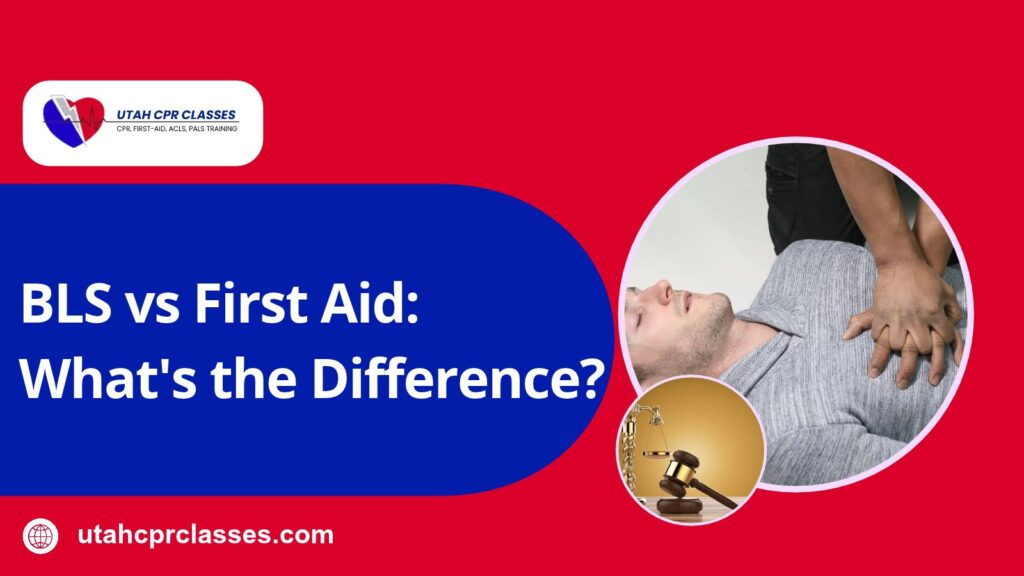
BLS and First Aid are both essential emergency response training programs, but they prepare you for different types of emergencies. Basic Life Support (BLS) focuses on life-threatening cardiac and respiratory emergencies, including CPR, AED use, rescue breathing, and choking response. First Aid covers a broader range of injuries and sudden illnesses, including bleeding, burns, wounds, fractures, allergic reactions, and shock.
The main difference between BLS and First Aid is the scope and purpose of the training. BLS emphasizes resuscitation and maintaining vital functions during cardiac arrest and respiratory emergencies, while First Aid focuses on providing immediate care for injuries and illnesses before professional medical treatment is available. Understanding this difference helps you choose the training that matches your job, workplace, school, or certification requirements.
This comparison guide explains the differences between BLS and First Aid, including CPR, AED training, course content, and who needs each certification.
BLS vs First Aid at a Glance
| Feature | BLS | First Aid |
| Full form | Basic Life Support | First Aid |
| Main focus | Life-threatening emergencies | Injuries and sudden illnesses |
| CPR | Core component | May be included |
| AED | Core skill | May be included |
| Cardiac arrest | Major focus | Usually covered as part of CPR training |
| Choking | Covered | Covered |
| Bleeding and wounds | Limited focus | Major focus |
| Burns and injuries | Limited focus | Major focus |
| Healthcare professionals | Commonly required | May also be required |
| Workplace/general public | Depends on role | Commonly applicable |
| Team-based resuscitation | Often included | Usually less emphasized |
What Is BLS?
Basic Life Support (BLS) is emergency training focused on recognizing and responding to life-threatening cardiovascular and respiratory emergencies. It teaches essential skills such as high-quality CPR, AED use, rescue breathing, choking relief, and effective response during cardiac arrest.
BLS training is particularly important for healthcare professionals and others who may be responsible for responding to cardiac or respiratory emergencies. Depending on the course, BLS training can include adult, child, and infant resuscitation, ventilation, AED operation, and team-based resuscitation.
What Does BLS Training Cover?
Common BLS topics include:
- CPR: Performing high-quality chest compressions and appropriate ventilations.
- AED use: Using an automated external defibrillator during cardiac arrest.
- Rescue breathing: Providing ventilation when indicated.
- Choking response: Recognizing and treating severe airway obstruction.
- Cardiac arrest recognition: Identifying when CPR and an AED are needed.
- BLS Team dynamics: Coordinating effectively with other rescuers during resuscitation.
- Adult, child, and infant CPR: Applying appropriate techniques based on the patient’s age.
What Is First Aid?
First Aid is the immediate care provided to a person who is injured or becomes ill before professional medical treatment is available. It focuses on recognizing emergencies, providing appropriate initial care, preventing the condition from getting worse, and activating emergency medical services when necessary.
Unlike BLS, which focuses heavily on cardiac arrest, respiratory emergencies, CPR, and AED use, First Aid covers a broader range of injuries and illnesses. The exact topics depend on the course and training provider.
What Does First Aid Training Cover?
Common First Aid topics include:
- Bleeding: Controlling severe bleeding and caring for wounds.
- Burns: Providing appropriate initial care for thermal and other burns.
- Fractures and sprains: Recognizing and managing common musculoskeletal injuries.
- Choking: Responding to airway obstruction.
- Shock: Recognizing signs of shock and providing appropriate first aid.
- Sudden illness: Responding to conditions that cause a person to become suddenly ill.
- Seizures: Protecting the person from injury during a seizure.
- Allergic reactions: Recognizing serious allergic reactions and responding appropriately.
- Heat and cold emergencies: Providing initial care for conditions related to extreme temperatures.
- CPR and AED: Included in many combined First Aid, CPR, and AED courses.
Is CPR Included in BLS and First Aid?
Yes, CPR is included in BLS, and it is also included in some First Aid courses. However, CPR is a core component of BLS, while its inclusion in First Aid depends on the specific course.
The American Heart Association’s BLS course specifically teaches high-quality CPR for adults, children, and infants, along with appropriate breaths or ventilations, AED use, choking relief, and resuscitation team skills.
First Aid is different because it covers a broader range of injuries and illnesses. Some First Aid courses are offered as First Aid only, while others combine First Aid + CPR + AED. The AHA, for example, lists separate Heartsaver First Aid and Heartsaver First Aid CPR AED courses.
Is AED Training Included in BLS and First Aid?
Automated External Defibrillator (AED) training is typically included in BLS courses and may be included in First Aid courses, depending on the course format. BLS training places strong emphasis on using an AED during cardiac arrest because early defibrillation, along with high-quality CPR, is an important part of the response to sudden cardiac arrest.
First Aid training has a broader focus on injuries and sudden illnesses. A basic First Aid course does not necessarily include AED instruction. However, First Aid/CPR/AED courses specifically combine First Aid skills with CPR and AED training.
Therefore, if you need AED certification, check the course title and curriculum before enrolling. A course labeled simply “First Aid” may not provide the AED training you need, while a First Aid/CPR/AED course is specifically designed to include those skills.
Who Should Take BLS Training?
BLS training is designed for various roles such as healthcare professionals, healthcare students, and others whose roles require them to respond to cardiac arrest, respiratory emergencies, and other life-threatening situations.
BLS training is commonly appropriate for:
- Nurses and physicians
- EMTs and paramedics
- Dentists and dental professionals
- Medical assistants and other healthcare staff
- Healthcare and allied health students
- Pharmacists and other healthcare professionals
- Lifeguards and fitness professionals
- Coaches, teachers, and childcare professionals when required by their organization
- Workplace employees designated to provide emergency response
Who Should Take First Aid Training?
First Aid training is appropriate for anyone who may need to provide immediate care for injuries or sudden illnesses before professional medical help arrives. It is especially useful for people who work with children, employees, customers, athletes, or members of the public.
First Aid training is commonly appropriate for:
- Workplace employees and designated first aid responders
- Teachers and school staff
- Childcare providers and daycare workers
- Coaches, trainers, and athletic staff
- Camp counselors and recreational staff
- Lifeguards and outdoor professionals
- Parents, caregivers, and community members
- Employees whose workplace requires First Aid certification
- Anyone who wants practical emergency response skills
Do You Need First Aid If You Have BLS?
Yes. You still need First Aid training when your employer, school, organization, or professional requirement calls for First Aid certification. BLS and First Aid cover different areas of emergency response.
You need First Aid training when:
- Your employer requires First Aid certification.
- Your school, organization, or professional program requires First Aid.
- Your job involves responding to workplace injuries or medical emergencies.
- Your role involves caring for children, athletes, customers, or other people who need immediate care.
- You need training that covers emergencies beyond cardiac arrest and respiratory emergencies.
BLS certification does not automatically satisfy a separate First Aid requirement. When your role requires both certifications, complete training that provides both BLS and First Aid certification.
Do You Need BLS or First Aid?
Whether you need BLS or First Aid depends on your job, training requirements, and the type of emergencies you are expected to handle.
- Choose BLS if you are a healthcare professional, healthcare student, or your employer or credentialing organization specifically requires BLS certification.
- Choose First Aid if your role requires you to provide initial care for injuries, illnesses, and other non-cardiac emergencies.
- Choose First Aid/CPR/AED if your workplace or organization requires broader emergency response training that includes both First Aid and basic resuscitation skills.
- Choose both BLS and First Aid if your job, school, or organization requires separate certifications for both.
Can BLS and First Aid Be Taken Together?
Yes, BLS and First Aid can be taken together, but they are generally separate training programs with different focuses. Some training providers offer both courses through the same provider or as part of a broader emergency training program. First Aid courses may also be combined with Cardiopulmonary Resuscitation (CPR) and Automated External Defibrillator (AED) training.
Taking both can provide a more complete set of emergency response skills. If you need both, you can take BLS and First Aid separately or complete them through a provider that offers both courses. Always check the certification requirements before enrolling.
Get the Right Emergency Training
BLS and First Aid serve different purposes, so the right training depends on your role and certification requirements. BLS focuses on cardiac arrest, respiratory emergencies, CPR, AED use, choking response, and resuscitation, while First Aid covers a broader range of injuries and sudden illnesses, including bleeding, burns, wounds, fractures, allergic reactions, and shock. If your employer, school, licensing organization, or professional program requires BLS, First Aid, or both, complete the specific training required for your role. When both certifications are required, complete BLS and First Aid training that provides the appropriate credentials.
If you need BLS certification, enroll in an American Heart Association BLS class with Utah CPR Classes and complete your training around your schedule. The training is designed for busy professionals, allowing you to complete the online portion at your own pace and attend a short in-person skills session to complete your certification quickly. If you want both BLS and First Aid certification, you can add First Aid at the end of checkout and complete both certifications through the same training experience.