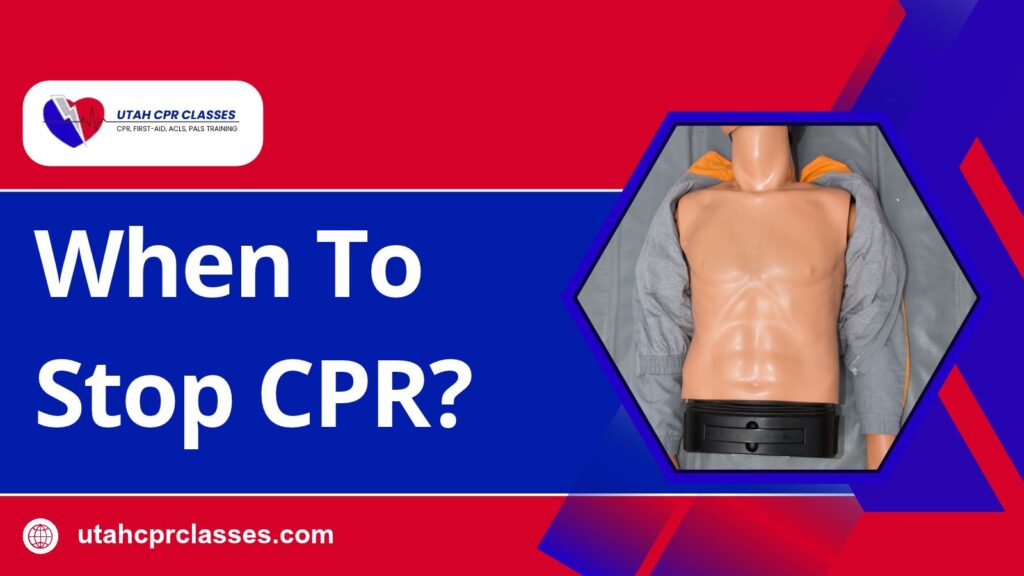
You should stop CPR when the person shows clear signs of life, a qualified responder takes over, you are physically unable to continue, the scene becomes unsafe, or a valid medical instruction requires resuscitation to stop. Until one of these situations occurs, continue CPR and follow the instructions provided by an AED or emergency dispatcher.
Knowing when to stop CPR is an essential part of effective cardiopulmonary resuscitation. CPR should continue with high-quality chest compressions and minimal interruptions while you wait for emergency medical services (EMS), use an automated external defibrillator (AED), and follow emergency dispatcher instructions. Understanding when to continue CPR and when to stop helps prevent unnecessary interruptions during resuscitation.
This guide explains when to stop CPR, when to pause chest compressions, and when CPR should continue.
Situations to stop CPR
CPR should continue without unnecessary interruptions until there is a clear reason to stop. In most situations, a rescuer should continue chest compressions while waiting for emergency medical services (EMS) and use an automated external defibrillator (AED) when one is available.
You should stop CPR in the following situations:
1. Return of Spontaneous Circulation (ROSC)
Return of spontaneous circulation (ROSC) occurs when the person’s heart begins pumping blood effectively again after cardiac arrest. When ROSC occurs, you should stop chest compressions and reassess the person.
Signs that may indicate ROSC include:
- Normal breathing
- Purposeful movement
- Coughing
- Opening the eyes or responding to you
- A detectable pulse, when assessed by a trained healthcare professional
Do not mistake agonal gasping for normal breathing or ROSC. If the person remains unresponsive and is not breathing normally, continue CPR and follow the AED’s instructions.
2. EMS or Another Qualified Responder Takes Over
Continue CPR until EMS personnel or another qualified responder takes over the person’s care. When trained responders arrive, follow their instructions and allow them to assess the person’s condition and continue or modify resuscitation as appropriate.
If another trained rescuer is available before EMS arrives, they can take over chest compressions when you become fatigued. This is a change of rescuer, not a reason to stop CPR. Coordinate the switch and keep any interruption in chest compressions as brief as possible.
When EMS takes over, tell them what you observed and what actions you performed, including when CPR began, whether an AED was used, and whether the AED delivered any shocks.
3. You Become Physically Unable to Continue
CPR is physically demanding, and prolonged chest compressions can cause significant fatigue. If you become too exhausted to perform effective chest compressions, you may need to stop if no other trained rescuer is available to take over.
If another trained rescuer is present, switch compressors rather than stopping CPR. Changing the person performing compressions allows CPR to continue while helping maintain adequate compression quality. Keep the transition as brief as possible to minimize interruptions in chest compressions.
If you are alone and become physically unable to continue, prioritize your own safety and contact or follow instructions from EMS or the emergency dispatcher when possible.
4. The Scene Becomes Unsafe
Do not continue CPR if the environment creates an immediate danger to you or the person receiving care. Potential hazards can include fire, electrical hazards, moving traffic, violence, structural instability, or other dangerous conditions.
A rescuer should not put their own life at serious risk to continue CPR. If the scene becomes unsafe, move away from the hazard when possible and follow instructions from emergency services.
5. A Valid DNR Order or Other Authorized Instruction Applies
A Do Not Resuscitate (DNR) order is a medical order stating that CPR should not be performed if a person’s heart or breathing stops. If you are performing CPR and a valid DNR order that clearly applies to the person and situation is identified, CPR should be stopped and EMS or other appropriate medical personnel should be contacted or allowed to take over.
You may identify a DNR instruction through:
- An official DNR form or document
- Approved medical identification, such as a bracelet or necklace
- Medical records or documentation available to authorized healthcare personnel
- Confirmation from EMS, healthcare professionals, or another authorized person
Do not assume that every advance directive, medical document, or verbal statement automatically constitutes a valid DNR order. DNR requirements vary by jurisdiction and healthcare setting. If you are unsure whether the documentation is valid or applies to the emergency, contact EMS or the emergency dispatcher and follow their instructions.
Does an Interruption in Chest Compressions Amount to Stopping CPR?
No. A brief interruption in chest compressions does not necessarily mean CPR has been stopped.
Certain interruptions can be necessary during resuscitation. For example, chest compressions may be briefly interrupted when:
- An AED analyzes the heart rhythm
- An AED delivers a shock
- Rescuers change compressors
- The person’s condition needs to be reassessed
- Another necessary intervention is performed
The goal is to minimize interruptions in chest compressions and resume compressions as soon as appropriate. Stopping CPR means terminating resuscitation rather than temporarily pausing compressions for an appropriate intervention.
Should You Stop CPR If the AED Says No Shock Is Advised?
No. A “no shock advised” message is not a reason to stop CPR. An automated external defibrillator (AED) analyzes the person’s heart rhythm and determines whether a defibrillation shock is appropriate. Some cardiac arrest rhythms are not treated with an AED shock.
If the AED says “no shock advised,” follow its voice or visual instructions and resume CPR when instructed. Do not interpret “no shock advised” as “the person is fine” or as a signal that resuscitation should end. Continue following the AED prompts until the person shows signs of life or another appropriate reason to stop CPR occurs.
Should You Stop CPR If the Person Is Gasping?
No. Gasping is not normal breathing and is not, by itself, a reason to stop CPR.
A person experiencing cardiac arrest may have abnormal breathing called agonal breathing. Agonal gasps can appear as:
- Occasional gasps
- Irregular breaths
- Snorting sounds
- Grunting
- Labored or abnormal breathing
These breaths can be mistaken for normal breathing. If the person is unresponsive and not breathing normally, continue CPR and use an AED as soon as one is available.
What Should You Do While Waiting for EMS?
If you are performing CPR while waiting for EMS, continue resuscitation and follow emergency dispatcher or AED instructions.
You should:
- Continue high-quality CPR.
- Use an AED as soon as it is available.
- Follow the AED’s voice or visual prompts.
- Minimize unnecessary interruptions in chest compressions.
- Switch compressors when needed if another trained rescuer is available.
- Continue until EMS or another qualified responder takes over, the person shows signs of life, you cannot physically continue, or another appropriate stopping condition occurs.
Do not stop CPR simply because EMS has not arrived after a certain amount of time. There is no universal time limit after which a lay rescuer should automatically discontinue CPR.
Common Mistakes When Stopping CPR
Knowing when to stop CPR is important, but stopping resuscitation too early can prevent the person from receiving continuous lifesaving care. Common mistakes include:
Stopping Before EMS Takes Over
If emergency responders have been called but have not yet arrived, do not stop CPR simply because you are waiting for them.
Continue CPR while waiting for EMS unless the person shows signs of recovery, you become physically unable to continue, the scene becomes unsafe, or another appropriate reason to stop occurs.
Assuming the Person Is Recovering Because They Move
A cough, gasp, twitch, or occasional movement does not necessarily mean that normal circulation and breathing have returned.
Look for clear signs of recovery, particularly normal breathing and purposeful responsiveness. If you are uncertain, follow the emergency dispatcher’s instructions.
Failing to Restart CPR When Needed
If a person briefly starts breathing normally but then becomes unresponsive and stops breathing normally again, CPR may need to be restarted.
Continue monitoring the person until emergency medical professionals take over.
Not Following AED or Dispatcher Instructions
An AED and emergency dispatcher can provide important instructions during cardiac arrest. Ignoring those instructions or delaying recommended actions can lead to unnecessary interruptions in resuscitation.
Stopping Because You Are Concerned About Injuries
Chest compressions can cause injuries, including broken ribs. However, CPR is performed during a life-threatening emergency. Concern about possible injury should not normally be a reason to withhold or unnecessarily stop effective CPR.
Taking Long or Unnecessary Breaks
CPR involves brief interruptions when necessary, such as during AED analysis or when switching rescuers. However, unnecessary or prolonged interruptions in chest compressions should be avoided. Resume compressions as soon as instructed.
Stopping Because the Person Has Not Responded
A lack of an immediate visible response does not mean CPR is unsuccessful. Continue CPR while the person remains unresponsive and is not breathing normally, unless a recognized reason to stop occurs.
Stopping After a Fixed Amount of Time
There is no universal rule that says a bystander should stop CPR after 10, 20, or 30 minutes. The duration of resuscitation depends on the circumstances and, when available, assessment by trained medical professionals.
Learn When to Start and Stop CPR
Knowing when to stop CPR is essential for safe and effective resuscitation. Continue CPR until the person shows signs of life, a qualified responder takes over, you cannot physically continue, the scene becomes unsafe, or an appropriate medical instruction requires stopping. Do not stop simply because the person is gasping, the AED says “no shock advised,” or a certain amount of time has passed.
Ready to build your CPR skills? Join our BLS certification course in Utah, designed for both healthcare and non-healthcare professionals. Get certified in as little as one day with a convenient format that lets you complete the online portion and a short hands-on skills session, ideal for busy professionals who want practical, recognized CPR and BLS training.