
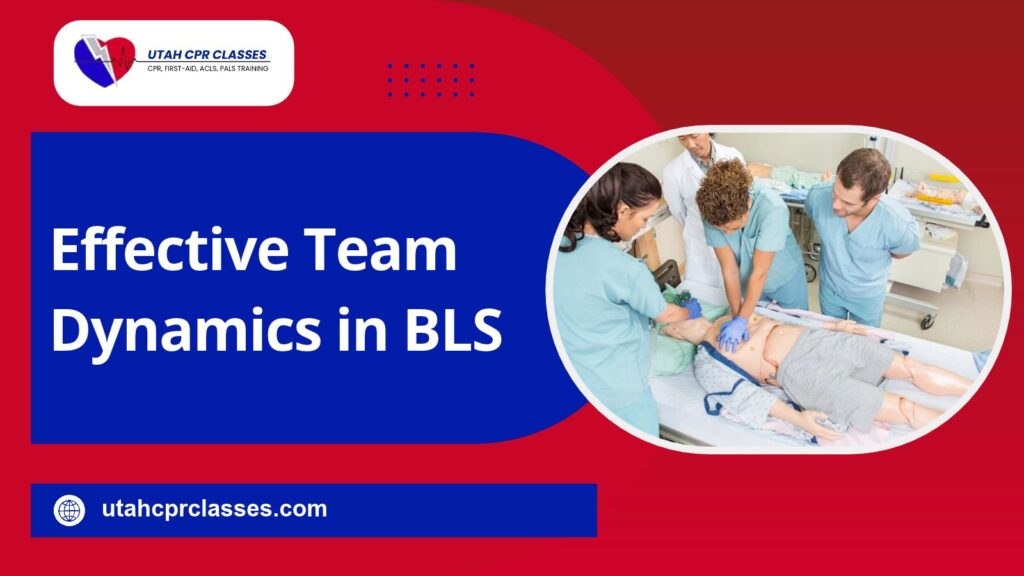
Effective team dynamics in Basic Life Support (BLS) help rescuers work together during cardiac arrest and other life-threatening emergencies. BLS team members must coordinate chest compressions, airway management, ventilation, AED use, and other critical tasks while maintaining clear communication and awareness of the resuscitation.
When multiple rescuers respond to a cardiac arrest, individual BLS skills are only part of an effective response. Clear roles, leadership, closed-loop communication, task delegation, mutual monitoring, and coordinated transitions help the team perform CPR efficiently and reduce unnecessary interruptions. Strong teamwork also allows rescuers to recognize problems, provide constructive feedback, and adapt as the resuscitation develops.
This blog explains the key elements, roles, and strategies that support effective team dynamics in BLS.
What Are Team Dynamics in BLS?
Team dynamics in Basic Life Support (BLS) refer to how rescuers work together during a cardiac or respiratory emergency. It involves the way team members coordinate their actions, share information, respond to changing conditions, and maintain awareness of the overall resuscitation effort.
In a BLS emergency, multiple rescuers may need to perform different tasks at the same time, such as performing CPR, using an AED, managing the airway, or monitoring the patient. Effective team dynamics help these activities function as a coordinated response rather than as separate actions. Strong team dynamics allow rescuers to understand how their individual actions contribute to the overall resuscitation. This coordination is particularly important when the situation changes quickly or when several interventions need to occur with minimal interruption to CPR.
Ultimately, effective BLS teamwork helps create a structured, coordinated, and responsive approach to cardiac arrest care.
Why Effective Team Dynamics Matter in BLS
Effective team dynamics matter in Basic Life Support (BLS) because cardiac arrest requires rapid, coordinated, and organized action. When several rescuers respond, they must work together while performing CPR, using an AED, providing ventilations, and monitoring the patient’s condition.
Strong team dynamics also help the team:
- Respond quickly when cardiac arrest is recognized
- Maintain high-quality CPR
- Coordinate AED use with ongoing resuscitation
- Reduce unnecessary interruptions in chest compressions
- Recognize and address problems during CPR
- Manage transitions between team members
- Maintain awareness of the patient’s condition
- Adapt responsibilities as the situation changes
The goal of effective BLS teamwork is to ensure that individual rescuers function as one coordinated team, allowing critical interventions to be performed efficiently and consistently throughout the resuscitation.
Elements of Effective BLS Team Dynamics
Effective BLS team dynamics involve more than knowing how to perform CPR. Rescuers need to coordinate their responsibilities, communicate important information, monitor the quality of resuscitation, and adapt as the emergency develops. The following elements help create an organized and efficient BLS team response.
1. Clear Roles and Responsibilities
Each rescuer should understand their specific responsibility during the resuscitation. Clearly defined roles reduce confusion, prevent duplicated tasks, and make it easier to identify whether an important intervention has been completed.
Example: One rescuer performs chest compressions, another manages the airway and ventilations, while another retrieves and operates the AED. A designated team leader coordinates these activities.
2. Clear and Direct Communication
Communication should be concise, specific, and directed to the appropriate team member. Rescuers should avoid vague instructions or assumptions because several interventions may be occurring simultaneously during cardiac arrest.
Example: Instead of saying, “Someone get the AED,” the team leader says, “Alex, get the AED and bring it here.” Alex knows exactly what to do and that the task has been assigned to them.
3. Closed-Loop Communication
Closed-loop communication ensures that instructions are heard, understood, and completed. The person giving the instruction identifies the task, the assigned rescuer acknowledges it, performs the task, and reports completion.
Example: The team leader says, “Jordan, start chest compressions.” Jordan responds, “Starting compressions,” and begins CPR. Jordan can then communicate that compressions have started, confirming the task is underway.
4. Leadership
A team leader provides direction and maintains an overall view of the resuscitation. The leader assigns responsibilities, monitors the team’s performance, coordinates interventions, and adjusts the response when circumstances change.
Example: The team leader assigns one rescuer to compressions, another to airway management, and another to the AED. The leader then monitors the team’s progress rather than attempting to perform every task personally.
5. Coordination
Coordination ensures that different team members perform their responsibilities in a way that supports the overall resuscitation. CPR, ventilation, AED operation, and role changes should be organized so that one intervention does not unnecessarily interfere with another.
Example: While the compressor continues CPR, another rescuer prepares the AED. When the AED is ready to analyze the rhythm, the team coordinates the transition according to the device’s prompts and the applicable BLS protocol.
6. Task Delegation
Task delegation involves assigning specific responsibilities to available rescuers based on their training and the needs of the situation. Effective delegation distributes the workload and allows multiple necessary tasks to be addressed.
Example: Instead of personally leaving the patient to retrieve equipment, the team leader tells a specific rescuer, “Please bring the AED and return immediately.” The leader can continue coordinating the resuscitation while the other rescuer handles the equipment.
7. Mutual Monitoring
Team members should monitor the patient as well as the quality of the resuscitation. They can observe chest compression quality, compressor fatigue, interruptions, ventilation, AED activity, and whether assigned responsibilities are being completed.
Example: A rescuer notices that the compressor is becoming fatigued and that compression quality is declining. The rescuer communicates this to the team so another trained compressor can prepare to take over.
8. Situational Awareness
Situational awareness means understanding what is happening during the resuscitation, including the patient’s condition, interventions already performed, available equipment, and the next actions required. Team members should maintain awareness beyond their individual tasks.
Example: While performing compressions, a rescuer remains aware that the AED is being prepared nearby. The team can then coordinate the next step without having to stop and reorganize unnecessarily.
9. Constructive Intervention
Team members should speak up when they identify a problem that could affect the quality of resuscitation. Constructive intervention allows the team to address problems promptly without turning the correction into personal criticism.
Example: If compressions are becoming inconsistent because the compressor is tired, another team member can say, “Let’s prepare for a compressor change.” This addresses the performance issue while keeping the team focused on patient care.
10. Feedback
Feedback helps team members recognize effective performance and correct problems. During an emergency, feedback can help address immediate issues, while training feedback can help rescuers improve their technical and teamwork skills.
Example: After a practice scenario, the team leader tells the compressor that the transitions between compressors were well coordinated but that communication before the transition could be clearer next time.
11. Knowledge Sharing
Knowledge sharing involves communicating relevant observations and information with the rest of the team. Important information should not remain with one rescuer when it could affect the team’s decisions or actions.
Example: A rescuer notices that the AED has completed its analysis and communicates this to the team leader. The team can then coordinate the next action based on the AED’s instructions.
12. Adaptability
A BLS team should be able to adjust its responsibilities when the situation changes. Additional rescuers may arrive, a team member may become fatigued, equipment may become available, or the patient’s condition may change.
Example: When another trained rescuer arrives, the team leader assigns them to assist with compressions or another appropriate responsibility. The existing team members adjust their roles instead of continuing with the original arrangement.
13. Team Debriefing
Team debriefing involves reviewing the response after a resuscitation or training scenario. The team can discuss what happened, identify communication or coordination problems, and determine what could be improved during future responses.
Example: After a BLS training scenario, the team discusses whether roles were assigned clearly, whether communication was effective, whether CPR interruptions were minimized, and whether the AED was incorporated smoothly into the response.
BLS Team Roles During a Resuscitation
Clearly defined BLS team roles help rescuers divide responsibilities and coordinate CPR, airway management, AED use, and overall resuscitation. The specific roles depend on the number of trained rescuers available and the circumstances of the emergency.
Below are the roles during a resuscitation:
Team Leader
The team leader coordinates the overall resuscitation, assigns responsibilities, monitors team performance, and ensures that critical tasks are addressed. The leader maintains an overall view of the patient and team rather than unnecessarily performing every task.
Compressor
The compressor is one of the critical BLS roles in a high-performance team and is responsible for performing high-quality chest compressions while maintaining consistent CPR. The compressor should communicate when fatigue develops and coordinate with another trained rescuer to ensure a smooth transition when a compressor change is needed.
Airway Rescuer
The airway rescuer manages the airway and provides ventilations using appropriate equipment and techniques. This role requires coordination with the compressor to support effective CPR.
AED or Monitor/Defibrillator Operator
The AED operator retrieves and operates the AED, follows its prompts, and communicates important information to the team. This rescuer coordinates AED analysis and other device-related actions with the rest of the team.
Timer/Recorder
The timer or recorder tracks important interventions and timing when sufficient personnel are available. This allows other team members to remain focused on patient care and team coordination.
Role Flexibility
In smaller teams, one rescuer may perform multiple responsibilities. As additional trained rescuers become available, responsibilities can be redistributed to improve coordination and reduce workload.
How to Minimize Interruptions During Team-Based CPR
Minimizing interruptions during team-based CPR helps maintain high-quality chest compressions and supports effective resuscitation. Teams can reduce unnecessary pauses by coordinating tasks and preparing for transitions before they occur.
Below are effective ways to minimize interruptions during team-based CPR:
- Plan Compressor Changes: Prepare the next compressor before the current compressor becomes fatigued so the switch occurs quickly.
- Coordinate AED Use: Continue CPR while the AED is being prepared when appropriate, and follow the device’s instructions promptly during rhythm analysis and shock delivery.
- Coordinate Ventilations: The airway rescuer should prepare ventilation equipment and coordinate with the compressor to avoid unnecessary pauses.
- Use Clear Communication: Give short, direct instructions so team members understand when to start, stop, or change a task.
- Prepare Equipment Early: Position the AED and ventilation equipment before they are needed whenever possible.
- Assign Specific Roles: Defined responsibilities prevent multiple rescuers from attempting the same task or leaving critical tasks unattended.
- Monitor CPR Quality: Team members should watch compression performance and identify interruptions that can be prevented or shortened.
- Coordinate Transitions: Announce upcoming changes and have the incoming rescuer ready before the transition begins.
How to Improve BLS Team Dynamics
You can improve BLS team dynamics through clear role assignment, effective communication, coordinated practice, and continuous performance review.
- Assign Clear Roles: Designate responsibilities for leadership, compressions, airway management, AED operation, and timing.
- Use Closed-Loop Communication: Give direct instructions, acknowledge them, and confirm task completion.
- Practice as a Team: Conduct realistic BLS scenarios to build coordination and familiarity with team roles.
- Coordinate Compressor Changes: Prepare the next compressor before the change to minimize interruptions in chest compressions.
- Monitor Team Performance: Watch CPR quality, task completion, and team coordination throughout the resuscitation.
- Encourage Constructive Intervention: Speak up promptly when you identify a problem that could affect patient care.
- Maintain Situational Awareness: Stay aware of the patient’s condition, team activities, equipment, and changing priorities.
- Adapt Team Roles: Redistribute responsibilities when fatigue develops, tasks change, or additional rescuers arrive.
- Debrief After Resuscitation: Review communication, coordination, and CPR performance to identify areas for improvement.
Get Trained to Work Effectively as a BLS Team
Effective BLS team dynamics help rescuers communicate clearly, coordinate responsibilities, maintain high-quality CPR, and respond efficiently during cardiac arrest. BLS training gives you the skills and teamwork practice needed to perform CPR, use an AED, manage the airway, and work effectively with other rescuers during an emergency. Enroll in a BLS course to strengthen your emergency response skills and become better prepared to work as part of a coordinated resuscitation team.
Join a BLS certification class with Utah CPR Classes to learn effective team dynamics in BLS along with essential CPR, AED, and emergency response skills. You can complete the online portion on your schedule and attend a short in-person skills session to complete your AHA BLS certification. With a streamlined format designed for busy schedules, you can complete your BLS certification quickly while also having access to ACLS and PALS certification classes.