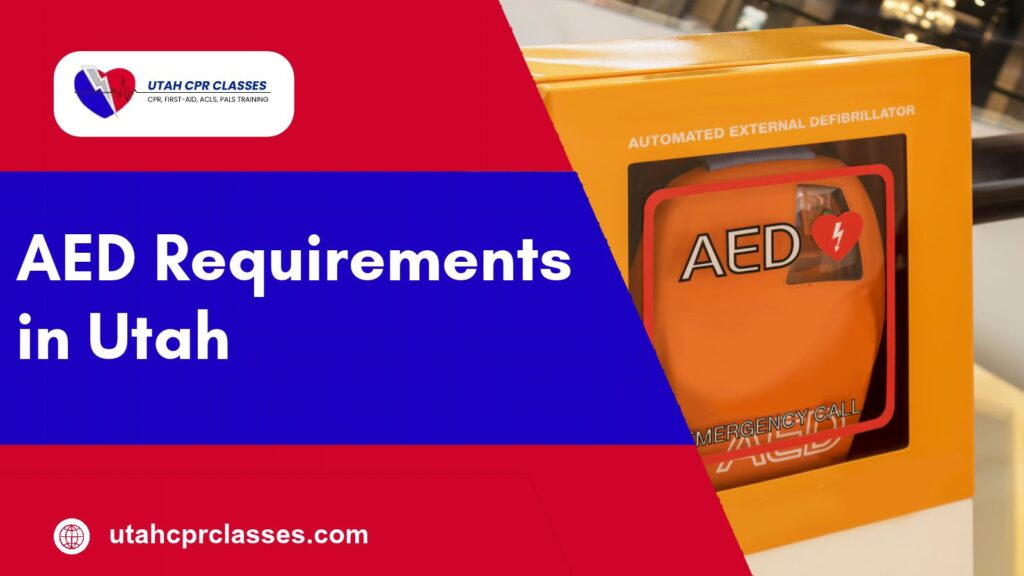
Utah AED requirements depend on the type of facility, where the automated external defibrillator (AED) is located, and the specific Utah law that applies. Utah does not require every business, workplace, or organization to purchase an AED. However, Utah law establishes requirements for AED location reporting, CPR and AED training encouragement, AED use, civil-liability protection, and AED tampering. Utah also has specific AED requirements for trampoline parks and schools.
Beginning with the 2026–2027 school year, each school within a Utah local education agency (LEA) must develop a Cardiac Emergency Response Plan (CERP) that includes specific requirements for AED placement, accessibility, signage, training, maintenance, and EMS notification. Utah law also requires qualifying AED owners or lessees to report the device’s location to the appropriate emergency medical dispatch center, generally within 14 days after installation or removal.
In this article, we will explain Utah AED requirements, including AED reporting, training, placement, maintenance, school requirements, and requirements for specific facilities.
Does Utah Require Businesses to Have an AED?
No. Utah does not have a blanket statewide law requiring every business to purchase an AED. Utah’s AED statutes establish requirements that apply when an AED is acquired, installed, or operated, but they do not require every private business to purchase a device.
However, Utah does require AEDs in certain settings. For example, trampoline parks must have an AED on the premises and an on-duty staff member trained to use the AED whenever the park is operating. Schools also have specific AED requirements under Utah’s cardiac emergency response plan law beginning with the 2026–2027 school year.
Businesses that voluntarily establish an AED program should address the device’s location, accessibility, reporting, training, maintenance, signage, and emergency response procedures.
Which Facilities Are Required to Have an AED in Utah?
Utah does not impose one AED requirement on every type of facility. The most important facility-specific requirements include:
- Trampoline parks: Must have an AED on the premises and an on-duty staff member trained in AED use whenever the park operates.
- Utah schools: Beginning with the 2026–2027 school year, schools within an LEA must implement a Cardiac Emergency Response Plan that includes appropriate AED placement and accessibility.
This distinction is important because saying that “Utah businesses are required to have AEDs” would overstate the law.
Utah AED Requirements for Schools
Utah has established specific AED requirements for schools through its Cardiac Emergency Response Plan (CERP) requirements.
Beginning with the 2026–2027 school year, each school within an LEA must develop a CERP that incorporates evidence-based core elements of emergency cardiovascular care.
A CERP is a school emergency plan addressing how school personnel respond when an individual experiences sudden cardiac arrest or a similar life-threatening emergency on school grounds.
The school CERP must address:
- AED placement
- AED accessibility
- AED signage
- First-aid training
- CPR training
- AED-use training
- AED testing and maintenance
- Notification of the appropriate emergency medical services provider
AED Placement Requirements for Utah Schools
Under Utah Code §53G-9-216, an LEA must ensure that each school’s CERP includes appropriate AED placement.
The school AED must:
- Be placed according to the school’s CERP.
- Follow applicable AED placement guidelines established by an organization focused on emergency cardiovascular care.
- Be identified with appropriate signage.
- Be located on school property or otherwise positioned so it is accessible within three minutes.
- Be maintained in an unlocked location that allows the AED to be placed on a person experiencing cardiac arrest within three minutes.
The three-minute accessibility requirement is one of the most important elements of Utah’s school AED law.
The purpose is to prevent an AED from being technically available but practically inaccessible during a cardiac emergency.
AED Training Requirements for Utah Schools
Utah’s CERP requirements require an LEA to designate appropriate school personnel for training in:
- First aid
- Cardiopulmonary resuscitation (CPR)
- AED use based on evidence-based guidelines
Relevant personnel may include:
- Educators
- School nurses
- Athletic trainers
The school must identify appropriate personnel and ensure that relevant staff receive the required training.
AED Maintenance Requirements for Utah Schools
Utah law requires an LEA to ensure that each school AED is tested and maintained according to the manufacturer’s operational guidelines.
Schools must also notify the appropriate first aid, ambulance, rescue squad, or other appropriate emergency medical services provider about:
- The AED
- The type of AED acquired
- The AED’s location
This means that purchasing an AED is only one part of complying with the school cardiac emergency response requirements.
Do Utah School AEDs Need Signs?
Yes.
Utah’s school CERP statute specifically requires the AED to be identified with appropriate signage.
Clear AED signage helps school staff, students, visitors, and emergency responders locate the device quickly during an emergency.
AED Requirements for Utah Trampoline Parks
Utah specifically requires trampoline parks to have an AED.
Under Utah’s trampoline park safety requirements, each trampoline park must have:
- An AED device on the premises
- An on-duty staff member trained in the use of the AED whenever the trampoline park is operating
Trampoline park staff must also receive safety training that includes first aid, CPR, blood-borne pathogens in accordance with applicable OSHA standards, and immediate care for breathing emergencies and serious injuries. The safety training must occur at least once per calendar year.
The trampoline park must also maintain an emergency response plan that addresses what to do and who to contact when an injury or serious injury occurs, including calling 911 for a serious injury.
Therefore, trampoline parks are an important exception to Utah’s general rule that businesses are not universally required to have an AED.
Does Utah Require AED Registration?
Utah requires qualifying AED owners or lessees to report the AED’s location.
Under Utah Code §26-8b-301, a person who owns or leases an AED must report specified information to the emergency medical dispatch center serving the location where the AED is installed when the person:
- Installs the AED
- Causes the AED to be installed
- Allows the AED to be installed
The same reporting requirement applies when an AED is removed from an installed location.
The reporting system allows emergency medical dispatch centers to maintain information about AED locations and provide that information during a potential sudden cardiac arrest emergency.
How Long Do You Have to Report an AED in Utah?
The report must be made within 14 days after the AED is installed or removed.
The reporting requirement does not apply to an AED:
- Located at a private residence
- Located in a vehicle
- Located in another mobile or temporary location
A private-residence AED may still be voluntarily reported to the appropriate emergency medical dispatch center.
Utah law also states that the department may not impose a penalty for failure to comply with the AED reporting requirement.
What Information Must Be Reported for an AED in Utah?
For a qualifying AED, the owner or lessee must report:
- Owner or lessee name
- Address
- Telephone number
- Exact AED location
The information is reported to the emergency medical dispatch center serving the location where the AED is installed. The report can be made in writing or through a web-based AED registration form when one is available.
When an AED is removed, the owner or lessee must report the removal and the location from which the AED was removed.
What Does the Utah Emergency Medical Dispatch Center Do With AED Information?
Utah’s emergency medical dispatch centers have specific responsibilities concerning reported AED locations.
The dispatch center must:
- Maintain a system for receiving and managing AED information.
- Record reported AED information within 14 days after receiving it.
- Inform a caller reporting a potential sudden cardiac arrest about an AED located at the address.
- Provide verbal instructions to help determine whether a person is experiencing cardiac arrest.
- Provide or offer instructions for CPR and AED use when appropriate.
- Provide AED information to the Bureau upon request.
This system connects AED location reporting with emergency dispatch and can help responders locate an AED during a cardiac emergency.
Do AED Sellers Have Reporting Responsibilities in Utah?
Yes. A person or business that sells or leases an AED must notify the purchaser or lessee in writing of the AED reporting requirements at the time the AED is provided, sold, or leased.
This requirement helps ensure that AED purchasers know they have a location-reporting responsibility after acquiring the device.
Who Can Use an AED in Utah?
A person does not need a medical license, CPR certificate, or other government authorization to use an AED when the person reasonably believes another individual is experiencing sudden cardiac arrest.
Utah Code §26-8b-201 provides that a person may use an AED without a license, certificate, or other governmental authorization when the person reasonably believes the other individual is in sudden cardiac arrest.
The same statute allows a person to administer CPR without a license, certificate, or other governmental authorization when the person reasonably believes another individual is experiencing sudden cardiac arrest.
This allows an AED to be used during an emergency without waiting for a licensed healthcare professional to arrive.
Is AED Certification Required in Utah?
No separate government-issued AED certification is required simply to use an AED during a qualifying emergency.
Utah law specifically permits a person to use an AED without a license, certificate, or other governmental authorization when the person reasonably believes someone is experiencing sudden cardiac arrest.
However, this does not mean AED training is unnecessary.
Utah law requires an AED owner or lessee to encourage each person likely to use the AED to complete courses in CPR and AED use.
For schools, the requirement is more specific: designated school personnel must receive training in first aid, CPR, and AED use under the CERP requirements.
For trampoline parks, an on-duty staff member trained in AED use must be present whenever the park operates.
Does Utah Require CPR and AED Training?
Utah law establishes different training requirements depending on the setting.
For General AED Owners
An AED owner or lessee must encourage people who are likely to use the AED to complete CPR and AED courses.
For Schools
Designated school personnel must be trained in:
- First aid
- CPR
- Use of AED based on evidence-based guidelines
For Trampoline Parks
Trampoline park staff must receive safety training that includes first aid and CPR, and the park must have an on-duty staff member trained in AED use whenever the park is operating.
Therefore, it is more accurate to say that Utah does not impose one universal AED-training requirement on every AED owner, but specific settings have specific training obligations.
Does Utah Law Protect People Who Use an AED?
Yes. Utah provides broad civil-liability protection for qualifying AED and CPR activities.
Utah Code §26-8b-202 protects several categories of people from civil liability for specified acts or omissions related to preparing for, responding to, or providing care to someone who reasonably appears to be experiencing sudden cardiac arrest.
Protected categories include, subject to the statutory conditions:
- People who administer or attempt to administer CPR
- People who use or attempt to use an AED
- CPR and AED instructors
- People who acquire an AED
- Owners or managers of premises where an AED is located
- People who retrieve an AED
- People who authorize or supervise AED installation
- People responsible for an AED program
- People involved in AED location reporting
- Certain physicians providing medical oversight or prescriptions
The liability protection does not apply to an act or omission constituting gross negligence or willful misconduct.
Does Utah Protect Untrained AED Users?
Utah law does not make AED use dependent on prior AED certification.
The authority to use an AED under Utah Code §26-8b-201 applies when a person reasonably believes another person is experiencing sudden cardiac arrest. The statute does not condition that authority on the rescuer first completing a CPR or AED course.
At the same time, Utah law encourages training for people likely to use an AED, and certain facilities have specific training requirements.
Therefore:
No AED certification is required to use an AED during a qualifying emergency, but AED training is strongly encouraged and is specifically required for certain personnel and facilities.
What Are the AED Maintenance Requirements in Utah?
Utah’s requirements differ depending on the facility.
For Utah schools, each AED must be tested and maintained according to the manufacturer’s operational guidelines.
For general AED programs, organizations should also follow the manufacturer’s instructions to keep the AED operational and ready for emergency use.
A practical AED maintenance program should include:
- Checking the AED’s operational status
- Monitoring battery condition
- Checking electrode pad expiration dates
- Replacing expired or used supplies
- Following manufacturer inspection requirements
- Keeping the device accessible
- Maintaining appropriate signage
- Ensuring the AED remains ready for emergency use
- Updating the reported location if the AED is moved
The exact maintenance schedule should come from the AED manufacturer’s instructions rather than assuming one universal replacement schedule.
Are AED Signs Required in Utah?
Yes, specifically for school AEDs under Utah’s CERP requirements.
Utah school law requires an AED to be identified with appropriate signage.
For AED programs generally, visible signage is also an important operational practice because responders need to locate the device quickly.
Utah law separately prohibits unauthorized removal, tampering with, or disturbance of an AED, AED cabinet or enclosure, or AED sign.
Is Tampering With an AED Illegal in Utah?
Yes. Under Utah Code §26-8b-501, a person commits a Class C misdemeanor by removing, tampering with, or otherwise disturbing an AED, its cabinet or enclosure, or its AED sign, unless a statutory exception applies.
Exceptions include situations where the person:
- Is authorized by the AED owner to inspect or maintain the device
- Is performing authorized repairs
- Is responding to or providing care to a potential sudden cardiac arrest patient
- Acts in good faith to support the recognized purposes of the AED
The law is intended to protect the availability and operational readiness of AED equipment.
Can an AED Be Used for Training in Utah?
Utah law distinguishes between operational AEDs and AEDs used solely for demonstration or training.
An AED used solely for demonstration or training purposes and not operational for emergency use is generally exempt from the chapter’s other AED provisions, subject to the specific statutory requirements.
The owner must clearly mark the exterior of the AED to indicate that it is for demonstration or training use only.
This distinction helps prevent a training device from being mistaken for an AED that is available for an actual emergency.
What Should a Utah Business Do If It Has an AED?
A Utah business that owns or leases an AED should establish an organized AED program rather than simply purchasing a device and placing it in a storage room.
1. Choose an Accessible Location
Place the AED where it can be retrieved quickly during a cardiac emergency.
2. Clearly Identify the AED
Use appropriate signage so employees and visitors can locate the device.
3. Report the AED Location
Complete the required location report within 30 days when Utah’s reporting law applies.
4. Encourage CPR and AED Training
Utah law requires AED owners or lessees to encourage people likely to use the AED to complete CPR and AED training.
5. Maintain the Device
Follow the manufacturer’s operational and maintenance requirements.
6. Establish an Emergency Response Procedure
Employees should know:
- Who calls 911
- Who starts CPR
- Who retrieves the AED
- Where the AED is located
- How to activate the emergency response system
- How to follow the AED’s prompts
7. Keep the AED Available
Avoid unnecessary barriers, locked storage, or other arrangements that could delay emergency access.
8. Update the AED Location
If the AED is moved or removed, update the required location information.
AED Requirements for Utah Workplaces
For most Utah workplaces, there is no blanket statewide law requiring every employer to install an AED.
However, an employer that voluntarily establishes an AED program should treat the device as part of its workplace emergency-response system.
A workplace AED program can include:
- AED placement
- AED location reporting
- CPR/AED training
- Emergency response procedures
- Maintenance checks
- Battery and electrode monitoring
- AED signage
- Employee awareness
- 911 activation procedures
Certain workplaces can also be subject to separate federal, licensing, industry, or facility-specific requirements, so employers should evaluate the rules applicable to their particular operation.
AED Requirements for Gyms and Fitness Facilities in Utah
Utah does not impose a blanket statewide requirement that every gym or fitness center have an AED.
However, gyms and fitness facilities can choose to establish AED programs because sudden cardiac arrest can occur during physical activity.
A fitness facility with an AED should consider:
- Placing the device where staff can retrieve it rapidly
- Training staff in CPR and AED use
- Clearly marking the AED location
- Maintaining the AED according to manufacturer requirements
- Reporting the AED location when required by Utah law
- Establishing a written emergency response procedure
If a particular fitness facility falls under another Utah-specific regulatory requirement, that requirement should be evaluated separately.
AED Requirements for Childcare Facilities in Utah
Utah’s general AED statutes do not create a blanket requirement that every childcare facility purchase an AED.
However, childcare providers can establish CPR/AED emergency-response procedures as part of their broader safety program.
If a childcare organization owns or leases an AED, the Utah AED reporting and other applicable requirements should be followed.
Any separate childcare licensing requirements should also be reviewed because AED requirements and CPR requirements are not necessarily the same thing.
Why AED Access Matters in Utah
Sudden cardiac arrest can occur in schools, workplaces, athletic facilities, gyms, trampoline parks, community buildings, healthcare facilities, and other public locations.
An AED analyzes the heart rhythm and determines whether a shock is appropriate. When defibrillation is indicated, rapid AED use combined with CPR can be an important part of the emergency response.
Utah’s AED laws therefore address several parts of emergency preparedness:
- AED access
- AED location reporting
- CPR and AED training
- AED maintenance
- Emergency response
- AED program management
- Legal protection for qualifying good-faith responders
Prepare Your Utah Organization for a Cardiac Emergency
AED access can make a critical difference during a sudden cardiac arrest emergency, but having an AED is only one part of an effective emergency response program. Proper placement, accessibility, maintenance, and training help ensure that employees know what to do when an emergency occurs.
If you want to get AED training for your workplace in Utah, contact Utah CPR Classes. You can schedule on-site group AED training for your employees, along with BLS, ACLS, and PALS certification when your workplace or staff members need additional certification. Training is available for both individuals and workplace groups, making it easier to build the right training program for your needs.
Contact Utah CPR Classes today to schedule AED, CPR, BLS, ACLS, or PALS training for your workplace or yourself.