Cardiac arrest is a life-threatening emergency that requires immediate action. CPR, or cardiopulmonary resuscitation, helps maintain blood circulation and oxygen delivery to the brain and other vital organs until an AED or emergency medical professionals can provide further treatment. Knowing the basic CPR sequence can help a bystander respond quickly when someone becomes unresponsive and is not breathing normally.
The CPR response involves more than chest compressions alone. It includes assessing scene safety, checking responsiveness and breathing, activating emergency medical services, performing high-quality chest compressions, providing rescue breaths when appropriate, and using an automated external defibrillator (AED). The specific CPR technique also differs for adults, children, and infants.
In this guide, you will learn the 7 steps of CPR, when each step is performed, common CPR mistakes to avoid, how CPR differs by age group, and the difference between Hands-Only CPR and conventional CPR.
What Are the 7 Steps of CPR?
The response begins with recognizing the emergency and quickly determining whether the scene is safe, whether the person responds, and whether normal breathing is present. Early chest compressions, emergency medical assistance, and rapid access to an AED are important parts of the response.
Although CPR techniques differ for adults, children, and infants, the basic response follows a logical sequence. The following 7 fundamental steps of CPR provide a simple way to understand what to do when responding to a suspected cardiac arrest.
1. Check the Scene for Safety
The first step of CPR is to check the scene for safety before approaching the person. Quickly look around for hazards that could put you, the person, or other bystanders in danger. Common hazards include moving traffic, fire, smoke, exposed electrical wires, dangerous equipment, unstable structures, or other immediate threats.
Scene safety is important because a rescuer who becomes injured can no longer provide effective assistance and could create another emergency. If the scene is unsafe, do not put yourself in unnecessary danger. Wait for appropriate emergency responders or address the hazard when it is safe to do so.
Once you determine that the scene is reasonably safe, approach the person and begin the initial assessment.
2. Check for Responsiveness
The second step of CPR is to check the person’s responsiveness. Approach the person, tap their shoulders, and speak loudly to determine whether they respond to your voice or touch.
Look for any purposeful response, such as speaking, opening their eyes, or moving normally. If the person responds, CPR is generally not indicated because the person is not unresponsive. Continue assessing the situation and provide appropriate assistance based on their condition.
If the person does not respond, treat the situation as a potential life-threatening emergency. Do not spend a prolonged amount of time trying to wake the person. Move quickly to assess breathing and activate emergency medical assistance.
3. Activate Emergency Medical Services and Get an AED
The third step is to activate emergency medical services and get an automated external defibrillator (AED). If another person is nearby, give them specific instructions, such as telling one person to call emergency services and another to retrieve the nearest AED.
An AED is an important part of the cardiac arrest response because it can analyze the person’s heart rhythm and determine whether a defibrillation shock is advised. The American Heart Association recommends obtaining and using an AED as soon as it is available during an adult cardiac arrest response.
If you are alone, follow the emergency response system’s instructions. For an unresponsive adult who is not breathing normally, activate emergency medical services and begin the appropriate CPR response without unnecessary delay.
4. Check for Normal Breathing
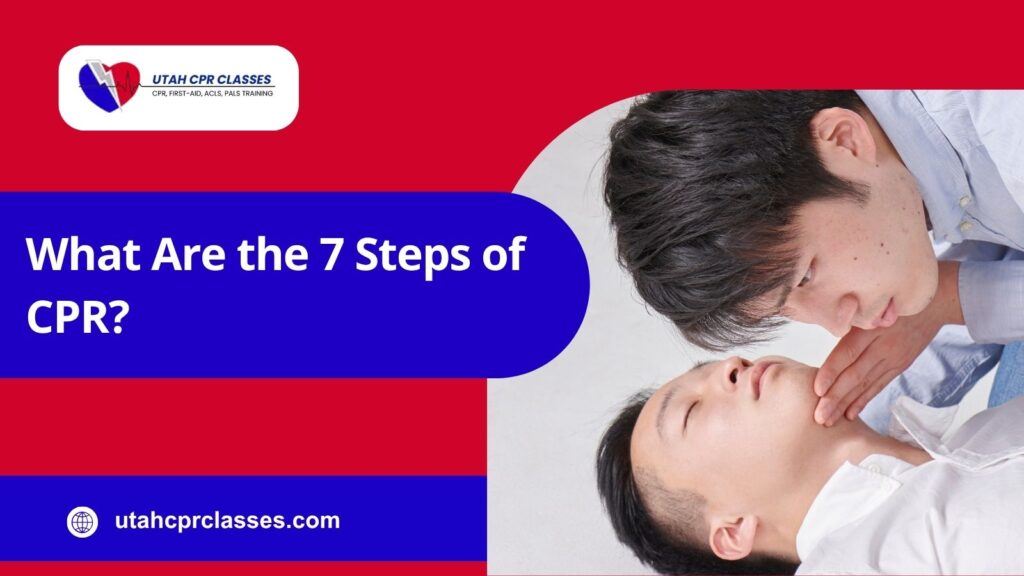
The fourth step of CPR is to check whether the person is breathing normally. Look at the person’s chest and determine whether you see normal, regular breathing.
If the person is unresponsive and is not breathing normally, or is only gasping, begin CPR. Gasping is not normal breathing. A person in cardiac arrest can make occasional abnormal gasping sounds or movements that might appear to be breathing, but these should not cause you to delay CPR. The AHA’s adult BLS algorithm specifically identifies no breathing or only gasping as a condition requiring the CPR response.
The breathing assessment should be brief. The goal is to recognize whether normal breathing is present, not to spend valuable time trying to determine the exact cause of the person’s condition. For trained healthcare professionals, pulse assessment is also part of the adult BLS assessment. Untrained bystanders should not delay CPR because they are unable to confidently determine whether a pulse is present.
5. Start Chest Compressions
The fifth step of CPR is to start chest compressions when the person is unresponsive and not breathing normally. Chest compressions are the core component of CPR because they help circulate blood to the brain and other vital organs during cardiac arrest.
For adult CPR, place the heel of one hand on the center of the person’s chest and place the other hand on top. Position your shoulders over your hands and keep your arms straight so you can use your upper body to deliver effective compressions.
Perform compressions at a rate of 100 to 120 compressions per minute. For an average adult, compress the chest at least 2 inches (5 cm) while avoiding excessive compression depth greater than approximately 2.4 inches (6 cm). Allow the chest to fully recoil after each compression rather than leaning on the chest between pushes.
Minimize interruptions in chest compressions. Every unnecessary pause reduces the time spent actively circulating blood. If another trained rescuer is available, rescuers can switch roles when needed to maintain effective compressions and reduce fatigue.
6. Give Rescue Breaths When Appropriate
The sixth step is to provide rescue breaths when appropriate and when the rescuer is trained and willing to do so. Rescue breaths provide oxygen to the lungs while chest compressions circulate blood through the body.
For trained rescuers performing conventional CPR on an adult, the standard approach is 30 chest compressions followed by 2 rescue breaths. Each breath should be delivered over about one second and should produce visible chest rise. After the two breaths, immediately return to chest compressions.
Rescue breaths are particularly important when cardiac arrest is associated with a lack of oxygen, including drowning and many pediatric emergencies. For a member of the general public witnessing a sudden cardiac arrest in an adult or teenager, Hands-Only CPR is an alternative that consists of calling emergency services and performing continuous chest compressions.
The type of CPR provided should therefore reflect the rescuer’s training, the person’s age, and the circumstances of the emergency.
7. Use the AED and Continue CPR
The seventh step of CPR is to use the AED as soon as it is available and continue CPR according to the AED’s instructions. Turn on the AED, expose the person’s chest, and apply the adhesive pads according to the diagrams on the device.
Once the pads are attached, the AED analyzes the person’s heart rhythm. Follow the device’s voice or visual prompts and make sure nobody touches the person while the AED is analyzing the rhythm or delivering a shock.
If the AED advises a shock, ensure everyone is clear of the person before the shock is delivered. After the shock, or if the AED determines that a shock is not advised, resume CPR immediately as directed. The AHA adult BLS algorithm instructs rescuers to continue CPR and follow AED prompts, with CPR typically continuing for approximately two minutes before another rhythm analysis.
Continue CPR and AED-guided care until the person shows signs of life, emergency medical professionals take over, the scene becomes unsafe, or you are physically unable to continue. CPR is not a single action that is completed once. It is a continuous emergency response designed to maintain circulation until definitive treatment or professional care becomes available.
Can You Skip Any CPR Steps?
You should not intentionally skip essential CPR actions when responding to someone in cardiac arrest. However, the exact CPR approach can vary depending on the person’s age, the situation, and your level of training.
For an unresponsive adult who is not breathing normally or is only gasping, the American Heart Association recommends acting quickly by activating the emergency response system and starting CPR. If an AED is available, use it as soon as possible and follow its instructions.
If you are an untrained bystander or are unwilling to provide rescue breaths, you can perform Hands-Only CPR for a teen or adult who suddenly collapses. This involves calling emergency services and pushing hard and fast in the center of the chest.
The key is not to delay CPR because you are worried about performing every step perfectly. Start chest compressions promptly and follow emergency dispatcher or AED instructions when available.
Do CPR Steps Differ by Age Group?
The basic CPR sequence is similar for adults, children, and infants, but compression depth, hand placement, rescue breathing, and technique vary based on age and body size.
Adult CPR
For adults, perform chest compressions at 100 to 120 per minute to a depth of at least 2 inches (5 cm). Trained rescuers generally use 30 compressions followed by 2 rescue breaths, while untrained bystanders can perform Hands-Only CPR for a sudden adult or teenage collapse.
Child CPR
For children from about 1 year to puberty, compress the chest to about one-third of its depth, approximately 2 inches (5 cm). Use one or two hands depending on the child’s size. Use 30:2 when alone and 15:2 with two trained rescuers.
Infant CPR
For infants younger than 1 year, compress the chest to about one-third of its depth, approximately 1.5 inches (4 cm). A single rescuer generally uses two fingers, while two trained rescuers use the two-thumb-encircling-hands technique. Use 30:2 when alone and 15:2 with two trained rescuers.
Does Completing CPR Steps Restart the Heart?
No, CPR does not necessarily restart the heart. The primary purpose of CPR is to maintain blood circulation and deliver oxygen to the brain and other vital organs when the heart is no longer pumping effectively. Chest compressions create artificial circulation while emergency medical care is being provided.
An AED may restart an abnormal heart rhythm when the cardiac arrest is caused by a shockable rhythm, such as ventricular fibrillation or pulseless ventricular tachycardia. The AED analyzes the heart rhythm and delivers a shock only when indicated. CPR should continue while waiting for the AED and between rhythm analyses because it helps maintain circulation until the heart can potentially be restored to an effective rhythm.
Therefore, completing the seven CPR steps should not be viewed as a process that automatically restarts the heart. CPR buys time by maintaining circulation, while an AED and advanced medical treatment address the underlying cardiac arrest.
What Are Common Mistakes During CPR Steps?
Common CPR mistakes often involve delaying chest compressions, performing compressions incorrectly, taking unnecessary pauses, or failing to use an AED when one is available. Understanding these errors can help rescuers respond more effectively during a cardiac emergency.
Common CPR mistakes include:
- Delaying CPR: Waiting too long to begin chest compressions can delay circulation support during cardiac arrest.
- Compressing too slowly: For adult CPR, the recommended rate is 100–120 compressions per minute.
- Not compressing deeply enough: Adult chest compressions should generally be at least 2 inches (5 cm) deep while avoiding excessive depth.
- Failing to allow full chest recoil: Let the chest return fully between compressions instead of leaning on it.
- Taking unnecessary pauses: Keep interruptions in chest compressions as short as possible.
- Incorrect hand placement: For adults, place your hands in the center of the chest and maintain proper body positioning.
- Ignoring an available AED: If an AED is available, use it as soon as possible and follow its voice or visual instructions.
- Stopping CPR too early: Continue until trained emergency responders take over, the person shows signs of life, the scene becomes unsafe, or you are unable to continue.
- Being afraid to help: An untrained bystander can use Hands-Only CPR for a teen or adult who suddenly collapses rather than waiting for a trained professional.
What Is the Difference Between Hands-Only CPR and Conventional CPR?
The main difference between Hands-Only CPR and conventional CPR is the use of rescue breaths. Both methods use chest compressions to help maintain blood circulation during cardiac arrest, but conventional CPR combines chest compressions with rescue breathing.
Hands-Only CPR
Hands-Only CPR involves calling emergency medical services and performing continuous chest compressions without rescue breaths. It is recommended for untrained bystanders who witness a sudden collapse in an adult or teenager. The rescuer pushes hard and fast in the center of the chest at 100 to 120 compressions per minute until help arrives or the person shows signs of life.
Conventional CPR
Conventional CPR combines chest compressions with rescue breaths. For trained rescuers treating an adult, the standard sequence is 30 chest compressions followed by 2 rescue breaths. Rescue breaths are particularly important in situations such as drowning and many pediatric cardiac arrests, where a lack of oxygen can play a significant role.
Get Hands-On CPR Training in Utah
Knowing the 7 steps of CPR can help you respond quickly and appropriately when someone experiences cardiac arrest. The key actions are to check the scene, assess responsiveness and breathing, activate emergency medical services, begin high-quality chest compressions, provide rescue breaths when appropriate, and use an AED as soon as it is available. CPR techniques vary for adults, children, and infants, so using the correct approach for the person’s age and situation is important. Whether you provide Hands-Only CPR or conventional CPR, taking prompt action and following emergency dispatcher or AED instructions can help maintain circulation until professional medical care takes over.
To help individuals build these lifesaving skills and earn certification, Utah CPR Classes provides American Heart Association (AHA) classes for CPR, BLS, ACLS, and PALS certification at multiple locations throughout Utah. You can complete your certification the same day, with unlimited retakes available. Choose a convenient location and book your certification class today to gain the skills and confidence needed to respond in an emergency.