
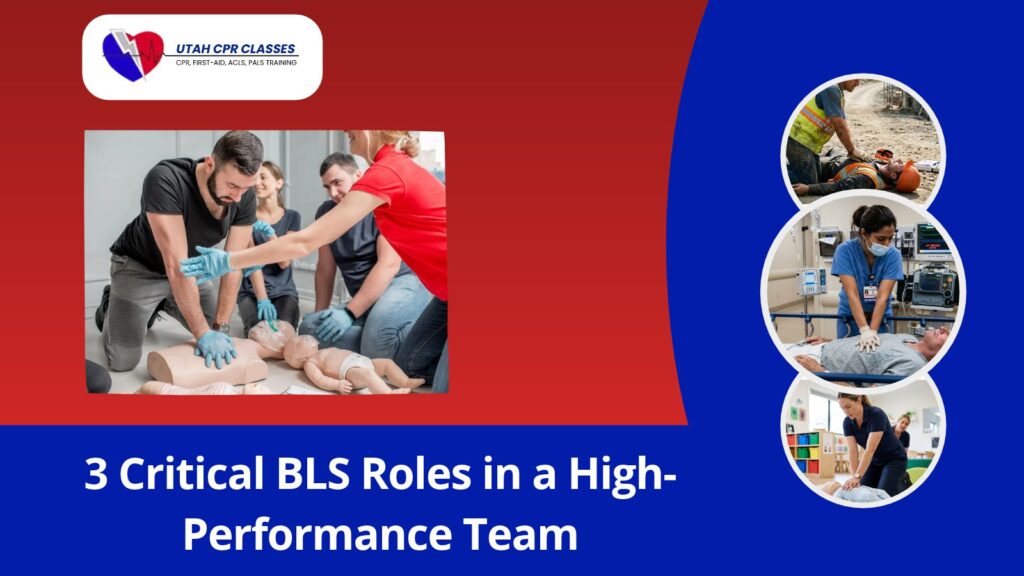
A high-performance BLS team plays a critical role in providing coordinated care during cardiac arrest. Effective basic life support (BLS) requires more than knowing how to perform Cardiopulmonary Resuscitation (CPR); it requires rescuers to work together, communicate clearly, and perform specific tasks without unnecessary delays. When team members have defined responsibilities, they can maintain high-quality chest compressions, provide effective ventilation, prepare the AED or defibrillator, and minimize interruptions during resuscitation.
Understanding BLS team roles is essential for anyone involved in CPR and emergency response. A well-organized resuscitation team typically assigns specific responsibilities to rescuers so that critical interventions can occur simultaneously and efficiently. The compressor focuses on high-quality chest compressions, the airway provider manages ventilation and the airway, and the monitor/defibrillator/CPR coach manages defibrillation while monitoring and supporting CPR quality.
This guide explains the 3 critical BLS roles in a high-performance team, including the compressor, airway provider, and monitor/defibrillator/CPR coach.
What Is a High-Performance BLS Team?
A high-performance BLS team is a group of trained rescuers who work together with defined responsibilities during cardiac arrest. Instead of having multiple rescuers perform overlapping tasks, each team member has a specific role and coordinates actions with the rest of the team.
High-performance resuscitation focuses on several elements, including:
- High-quality chest compressions
- Effective ventilation
- Rapid AED or defibrillator use
- Minimal interruptions in chest compressions
- Clear communication
- Defined team responsibilities
- Continuous CPR quality assessment
- Effective team dynamics
The American Heart Association’s high-performance team training emphasizes timing, CPR quality, coordination, defined team roles, CPR coaching, and chest compression fraction (CCF), along with effective team dynamics in BLS
The goal is not simply to perform CPR. The goal is to ensure that the entire team performs resuscitation in a coordinated manner while maintaining high-quality CPR.
What Are the 3 Critical BLS Roles in a High-Performance Team?
The 3 critical BLS roles in a high-performance team are compressor, airway provider, and monitor/defibrillator/CPR coach. Each role has a specific responsibility, and effective coordination between them helps maintain high-quality CPR throughout resuscitation.
Below, we discuss 3 critical roles in detail:
1. Compressor
The compressor is a critical role in a high-performance BLS team, responsible for maintaining effective chest compressions throughout cardiac arrest. This team member focuses on compression rate, depth, recoil, and minimizing interruptions so blood circulation can be maintained during CPR.
The compressor is responsible for:
- Maintaining the recommended compression rate and depth
- Allowing complete chest recoil after each compression
- Minimizing unnecessary interruptions
- Communicating when fatigue affects compression quality
- Rotating with another trained compressor when appropriate
For adult cardiac arrest, chest compressions should generally be performed at 100 to 120 compressions per minute with a depth of at least 2 inches (5 cm) while avoiding excessive depth.
2. Airway Provider
Another critical role in the BLS resuscitation team is the airway provider, who focuses on maintaining the airway and providing effective ventilation during CPR. This position requires close coordination with the compressor to support ventilation without creating unnecessary interruptions in chest compressions.
The airway provider is responsible for:
- Maintaining an open airway
- Providing appropriate ventilation
- Using a bag-mask device when indicated
- Using appropriate airway adjuncts within the provider’s scope of practice
- Coordinating ventilation with the compressor
- Communicating airway-related needs to the team
Effective airway management allows the team to address ventilation while the compressor continues focusing on high-quality chest compressions.
3. Monitor/Defibrillator/CPR Coach
The monitor/defibrillator/CPR coach serves a critical function by coordinating defibrillation and monitoring CPR performance. This team member manages the AED or defibrillator and, when acting as the CPR coach, provides real-time feedback to help maintain CPR quality.
This role includes:
- Preparing and operating the AED or defibrillator
- Coordinating rhythm analysis and defibrillation
- Monitoring CPR performance
- Providing feedback on compression quality
- Communicating important information to the team
- Helping minimize interruptions during CPR
By managing defibrillation and monitoring CPR performance, this role complements the work of the compressor and airway provider and helps keep the entire resuscitation team coordinated.
What Is the Combination of 3 Critical Roles in BLS Called?
The combination of the compressor, airway provider, and monitor/defibrillator/CPR coach is commonly referred to as the resuscitation triangle. These three positions form the core of a high-performance BLS team, with each rescuer responsible for a specific part of the resuscitation response.
The resuscitation triangle allows the team to coordinate three essential functions:
- Compressor: Performs and maintains high-quality chest compressions.
- Airway Provider: Manages the airway and provides appropriate ventilation.
- Monitor/Defibrillator/CPR Coach: Manages the AED or defibrillator and monitors or provides feedback on CPR quality.
These roles are designed to work simultaneously and collaboratively, rather than as separate tasks. The compressor maintains circulation, the airway provider supports ventilation, and the monitor/defibrillator/CPR coach coordinates rhythm assessment, defibrillation, and CPR feedback.
The arrangement also allows team members to communicate efficiently and anticipate the next intervention. When additional rescuers are available, roles such as team leader and timer/recorder can support the resuscitation team without replacing the three core positions.
Why These BLS Roles Matter
Clearly defined BLS roles are essential during cardiac arrest because effective resuscitation requires several interventions to happen in a coordinated manner. Assigning the compressor, airway provider, and monitor/defibrillator/CPR coach allows each team member to focus on a specific responsibility while maintaining communication with the rest of the team.
These roles matter because they help the team:
- Maintain high-quality CPR: The compressor can focus on compression rate, depth, recoil, and continuity without being distracted by other tasks.
- Minimize interruptions: Coordinated roles help the team prepare for rhythm analysis, defibrillation, and ventilation while limiting unnecessary pauses in chest compressions.
- Support effective ventilation: The airway provider can concentrate on airway management and ventilation while coordinating with the compressor.
- Integrate early defibrillation: The monitor/defibrillator role helps prepare the AED or defibrillator and coordinate rhythm analysis and shock delivery when indicated.
- Monitor CPR performance: The CPR coach can provide feedback on compression quality and help the team identify opportunities to improve CPR.
- Improve team coordination: Clearly assigned responsibilities reduce task duplication and help rescuers understand what they need to do during each stage of resuscitation.
- Support chest compression fraction: Efficient coordination can reduce hands-off time and help the team maintain a higher proportion of time performing chest compressions.
How to Build a High-Performance BLS Team
Building a high-performance BLS team requires more than having several trained rescuers available. Each team member needs a clearly defined responsibility, effective communication, and the ability to coordinate CPR, ventilation, and defibrillation without unnecessary delays.
Assign BLS Roles Early
Start by assigning the compressor, airway provider, and monitor/defibrillator/CPR coach as soon as enough rescuers are available. Clear role assignment prevents multiple team members from performing the same task while another important responsibility is left unattended.
Establish a Team Leader When Appropriate
A larger resuscitation team should have a team leader who coordinates the response, assigns responsibilities, communicates priorities, and monitors the overall resuscitation. The team leader should allow other rescuers to remain focused on their assigned roles rather than having everyone direct the response.
Focus on High-Quality CPR
The compressor should maintain appropriate compression rate, depth, recoil, and continuity. Other team members should support the compressor by anticipating interventions and avoiding unnecessary interruptions.
Coordinate Ventilation and Compressions
The airway provider should coordinate ventilation with the compressor and communicate clearly before and during airway-related interventions. This helps the team provide effective ventilation while limiting unnecessary interruptions in chest compressions.
Prepare the AED Early
The monitor/defibrillator/CPR coach should prepare the AED or defibrillator as soon as possible while other rescuers continue their assigned tasks. The team should coordinate rhythm analysis and defibrillation so that pauses in chest compressions are kept as short as possible.
Rotate the Compressor
Chest compressions are physically demanding, and fatigue can affect CPR quality. When multiple trained rescuers are available, the compressor should generally be rotated about every 2 minutes, or sooner if fatigue affects performance.
Use CPR Feedback
A CPR coach or audiovisual feedback device can help the team monitor compression rate, depth, recoil, and interruptions. Real-time feedback allows the team to identify problems and adjust CPR performance during the resuscitation.
Practice Team Communication
High-performance teams use clear, direct, and closed-loop communication. Team members should acknowledge instructions, communicate when tasks are completed, and immediately report important changes or problems.
For example, the monitor/defibrillator/CPR coach can announce when the AED is ready, while the compressor continues CPR until the team is prepared for rhythm analysis.
Debrief After Resuscitation
After the event, the team can review what happened, including CPR quality, communication, role assignment, interruptions, and timing of interventions. A structured debrief helps identify areas for improvement and strengthen future team performance.
How Does Communication Work Between BLS Team Members?
Effective communication keeps a high-performance BLS team coordinated during cardiac arrest. Because multiple interventions must occur at the same time, team members need to communicate clearly about roles, actions, timing, patient status, and CPR quality. Clear communication helps prevent duplicated tasks, missed interventions, and unnecessary interruptions in chest compressions.
Below are the techniques of communication between BLS team members:
1. Use Clear and Direct Instructions
BLS team members should use short, specific instructions rather than vague statements. Each instruction should identify who needs to act and what needs to be done.
For example:
“John, start compressions.”
“Sara, prepare the bag-mask.”
“Alex, bring the AED.”
This makes responsibilities clear and allows the team to act without confusion.
2. Use Closed-Loop Communication
Closed-loop communication helps confirm that an instruction has been heard and completed. The team member receiving an instruction acknowledges it, performs the task, and communicates when it is complete.
For example:
- Team leader: “Prepare the AED.”
- Rescuer: “Preparing the AED.”
- Rescuer: “AED is ready.”
This communication pattern helps the team know that an important task has been assigned and completed.
3. Communicate During CPR
Communication should continue throughout resuscitation rather than stopping after the initial role assignment. Team members should communicate when they need to change positions, when fatigue affects CPR quality, and when an intervention is ready.
The compressor, for example, should communicate when another rescuer needs to take over. The airway provider should communicate when ventilation is ready, while the monitor/defibrillator/CPR coach should communicate AED status and rhythm-analysis instructions.
4. Coordinate AED and Defibrillation
AED or defibrillator use requires precise communication because chest compressions need to pause during rhythm analysis and shock delivery. The team should clearly communicate when the device is ready, when everyone needs to stand clear, and when CPR should resume.
Clear communication helps minimize the duration of these necessary interruptions.
5. Provide Real-Time CPR Feedback
The CPR coach can communicate observations about compression rate, depth, recoil, and interruptions during resuscitation. Feedback should be specific and actionable.
For example, instead of saying “CPR quality is poor,” the coach can provide a direct correction such as:
“Increase compression depth.”
This allows the compressor to make an immediate adjustment.
6. Communicate Role Changes
Team members should clearly announce when responsibilities change. This is particularly important when rotating compressors because the incoming compressor needs to know when to take over without creating a prolonged pause in chest compressions.
What Other Roles Are Included in a High-Performance BLS Resuscitation Team?
The compressor, airway provider, and monitor/defibrillator/CPR coach form the core resuscitation triangle, but a larger high-performance resuscitation team can include additional roles. These positions help coordinate the overall response, document interventions, and manage tasks that extend beyond the three core BLS positions.
Here are other roles included in a high-performance BLS resuscitation team:
1. Team Leader
The team leader coordinates the overall resuscitation response. This person assigns responsibilities, communicates priorities, coordinates interventions, and monitors the team’s overall performance.
The team leader should maintain a broad view of the resuscitation while allowing other team members to concentrate on their assigned responsibilities.
2. Timer/Recorder
The timer/recorder tracks important events during resuscitation. This can include the timing of CPR cycles, rhythm checks, defibrillation attempts, medications, and other interventions.
Accurate timing and documentation help the team leader understand what has occurred and what intervention is due next.
3. IV/IO/Medication Provider
In a larger resuscitation team, an IV/IO/medication provider can establish vascular or intraosseous access and administer medications when indicated and within their scope of practice.
This role allows the compressor, airway provider, and other team members to remain focused on their primary responsibilities.
4. Additional Rescuers
Additional trained rescuers can provide support with equipment, compressor rotation, airway assistance, AED operation, or other tasks based on the needs of the resuscitation and their level of training.
The exact team structure depends on the number of rescuers, clinical setting, provider scope of practice, and applicable protocols. A small BLS response may involve only a few rescuers, while a larger healthcare resuscitation team can have several specialized positions.
Prepare With BLS Certification and Renewal Training
A high-performance BLS team depends on clearly defined roles, high-quality CPR, effective communication, and coordinated resuscitation. The compressor, airway provider, and monitor/defibrillator/CPR coach form the core of the team, while additional roles such as the team leader and timer/recorder support larger resuscitation responses. When each team member understands their responsibilities and works together with minimal interruptions, the team can maintain effective chest compressions, provide appropriate ventilation, prepare for defibrillation, and continuously monitor CPR quality throughout the resuscitation.
If you need to earn or renew your BLS certification, join a BLS certification or renewal class with Utah CPR Classes, an American Heart Association-authorized training provider. Complete the online portion at your own pace, then attend a self-guided skills session to complete your hands-on training. Once you complete the required components, you can receive your BLS certification quickly and get prepared to respond effectively during a cardiac emergency.