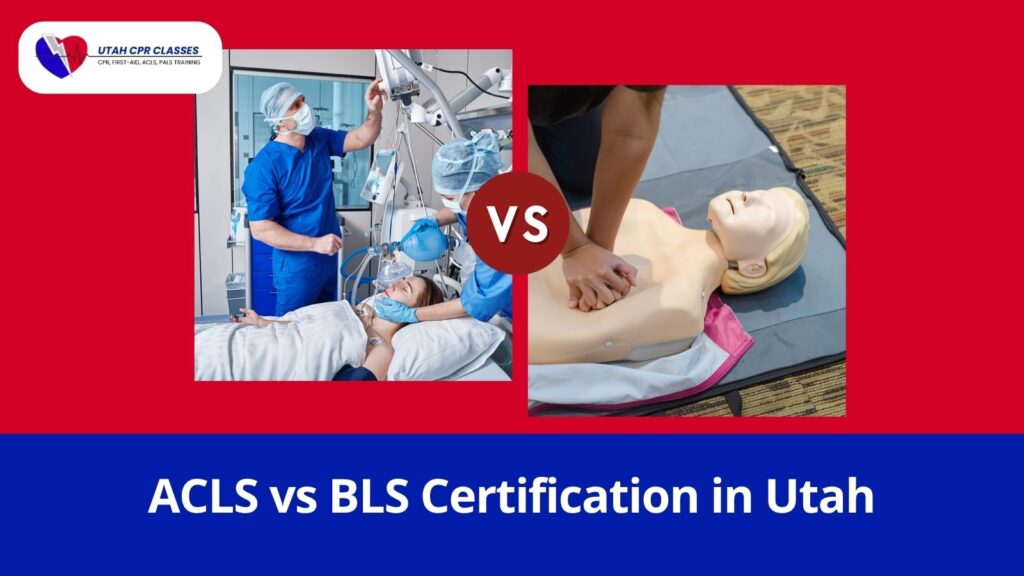
Whether you’re starting a healthcare career, preparing for clinical rotations, or advancing into emergency or critical care, choosing the right life support certification is an important step. Two of the most common certifications required by Utah healthcare employers are Basic Life Support (BLS) and Advanced Cardiovascular Life Support (ACLS). While both follow the American Heart Association (AHA) guidelines and prepare healthcare professionals to respond to medical emergencies, they differ significantly in their scope, complexity, and intended audience.
BLS focuses on the essential skills needed to recognize life-threatening emergencies, perform high-quality CPR, use an Automated External Defibrillator (AED), and provide basic airway support. ACLS builds on these foundational skills by teaching advanced interventions such as electrocardiogram (ECG) rhythm recognition, cardiac arrest algorithms, advanced airway management, emergency medications, and coordinated team leadership during cardiovascular emergencies.
Understanding the differences between ACLS and BLS certification in Utah can help you determine which course aligns with your profession, employer requirements, and long-term career goals. In this guide, we’ll compare both certifications, explain who needs each one, and help you decide which is right for you.
What Is BLS Certification?
Basic Life Support (BLS) is an American Heart Association certification designed for healthcare providers and other professionals who may need to respond to cardiac, respiratory, or choking emergencies. It teaches the core life-saving skills needed to provide immediate care until advanced medical treatment becomes available.
Unlike standard CPR courses for the general public, BLS is specifically intended for individuals working in healthcare environments where rapid recognition and response to medical emergencies are essential.
During a BLS course, students learn how to:
- Perform high-quality CPR for adults, children, and infants
- Use an Automated External Defibrillator (AED)
- Provide effective bag-mask ventilation
- Relieve foreign-body airway obstruction (choking)
- Work as part of a two-rescuer CPR team
- Recognize cardiac arrest and respiratory emergencies
- Minimize interruptions in chest compressions
BLS emphasizes delivering consistent, evidence-based care during the first few minutes of an emergency, when early intervention has the greatest impact on survival.
What Is ACLS Certification?
Advanced Cardiovascular Life Support (ACLS) is an advanced-level certification developed by the American Heart Association for healthcare professionals who manage cardiovascular emergencies. It expands on the CPR and AED skills learned in BLS by teaching providers how to assess, treat, and lead the management of critically ill patients experiencing cardiac arrest, stroke, or other life-threatening conditions.
ACLS focuses on both technical knowledge and clinical decision-making. Participants learn how to recognize abnormal heart rhythms, apply evidence-based treatment algorithms, administer emergency medications, and coordinate resuscitation efforts within a healthcare team.
An ACLS course typically includes training in:
- ECG rhythm interpretation
- Cardiac arrest algorithms
- Bradycardia and tachycardia management
- Acute coronary syndrome recognition
- Stroke assessment and treatment
- Advanced airway management
- Manual defibrillation and synchronized cardioversion
- Emergency cardiovascular medications
- Team communication and leadership
- Post-cardiac arrest care
Because ACLS assumes learners already understand CPR fundamentals, it is generally taken after developing proficiency in Basic Life Support.
ACLS vs. BLS Certification: Key Differences
Although Basic Life Support (BLS) and Advanced Cardiovascular Life Support (ACLS) are both American Heart Association (AHA) certifications designed to improve patient outcomes during medical emergencies, they differ in their purpose, target audience, training content, and clinical application. BLS provides the essential skills needed to respond to life-threatening emergencies, while ACLS expands on those fundamentals with advanced assessment, treatment, and team leadership techniques for managing cardiovascular emergencies.
The sections below compare ACLS and BLS across the most important factors to help you determine which certification best aligns with your role and career goals in Utah.
| Feature | BLS Certification | ACLS Certification |
| Primary Purpose | Provides immediate life-saving care through CPR, AED use, and basic airway management. | Prepares healthcare providers to manage advanced cardiovascular emergencies using evidence-based protocols. |
| Level of Care | Basic emergency care | Advanced cardiovascular emergency care |
| Target Audience | Healthcare students, nurses, dental professionals, medical assistants, therapists, and other patient care providers | Physicians, ICU and ER nurses, paramedics, nurse practitioners, physician assistants, anesthesiologists, and other advanced healthcare professionals |
| Prerequisites | No prior advanced life support training required | Strong BLS knowledge is recommended, and many employers require current BLS certification |
| Core Skills Taught | High-quality CPR, AED operation, rescue breathing, bag-mask ventilation, choking relief, and team-based CPR | ECG interpretation, advanced airway management, cardiac arrest algorithms, emergency medications, synchronized cardioversion, and team leadership |
| Medical Emergencies Covered | Cardiac arrest, respiratory arrest, choking, and unresponsive patients | Cardiac arrest, arrhythmias, stroke, acute coronary syndrome, post-cardiac arrest care, and other advanced cardiovascular emergencies |
| Course Difficulty | Beginner to intermediate | Intermediate to advanced |
| Career Applications | General patient care, outpatient clinics, dental offices, rehabilitation centers, and hospitals | Emergency departments, intensive care units, cardiac units, emergency medical services, and other critical care settings |
| Typical Cost | Lower due to shorter training | Higher because of advanced curriculum and longer training |
Purpose and Level of Care
Basic Life Support (BLS) certification prepares healthcare providers to deliver immediate life-saving care during cardiac, respiratory, and choking emergencies. The course focuses on recognizing life-threatening conditions, performing high-quality CPR, using an Automated External Defibrillator (AED), providing rescue breathing, and maintaining circulation until advanced medical assistance arrives. BLS serves as the foundation of emergency cardiovascular care and equips healthcare professionals with the essential skills needed to respond effectively in a wide range of clinical settings.
Whereas Advanced Cardiovascular Life Support (ACLS) certification prepares healthcare professionals to manage complex cardiovascular emergencies that require advanced assessment and intervention. In addition to reinforcing CPR and AED skills, ACLS covers ECG rhythm interpretation, advanced airway management, emergency medication administration, cardiac arrest algorithms, synchronized cardioversion, and post-cardiac arrest care. It is designed for providers responsible for delivering advanced treatment and leading resuscitation teams in critical care environments.
Certification Audience and Eligibility
Basic Life Support (BLS) certification is intended for healthcare providers who may need to perform CPR or respond to medical emergencies as part of their job. It is commonly required for nursing students, registered nurses, licensed practical nurses, certified nursing assistants, medical assistants, dental professionals, respiratory therapists, physical therapists, occupational therapists, and other allied healthcare workers. Because BLS teaches foundational life-saving skills, it is often the first certification healthcare professionals obtain before beginning clinical practice.
On the other hand, Advanced Cardiovascular Life Support (ACLS) certification is designed for healthcare professionals who manage critically ill patients and cardiovascular emergencies. It is commonly required for emergency physicians, ICU nurses, emergency department staff, paramedics, nurse practitioners, physician assistants, anesthesiologists, and cardiology teams. ACLS participants are generally expected to have a strong understanding of BLS concepts and CPR techniques before enrolling, as the course builds upon these essential skills.
Skills and Clinical Competencies
Basic Life Support (BLS) certification teaches the core clinical skills needed to respond to life-threatening emergencies. Participants learn adult, child, and infant CPR, AED operation, rescue breathing, bag-mask ventilation, choking relief, and effective team-based resuscitation. The emphasis is on performing high-quality CPR, recognizing cardiac arrest quickly, and providing immediate care that helps sustain life until advanced treatment is available.
In contrast, Advanced Cardiovascular Life Support (ACLS) certification develops more advanced clinical competencies required in high-acuity healthcare settings. Beyond CPR, learners are trained in ECG rhythm recognition, cardiac arrest algorithms, advanced airway management, pharmacology, manual defibrillation, synchronized cardioversion, stroke assessment, acute coronary syndrome management, and post-cardiac arrest care. ACLS also emphasizes critical thinking, rapid decision-making, and leadership during coordinated resuscitation efforts.
Medical Emergencies Covered
Basic Life Support (BLS) certification focuses on recognizing and responding to common life-threatening emergencies that require immediate intervention. The training prepares healthcare providers to manage cardiac arrest, respiratory arrest, airway obstruction, and unresponsive patients by performing CPR, using an AED, and supporting breathing until advanced medical personnel assumes patient care. Its primary objective is to preserve circulation and oxygenation during the initial stages of an emergency.
Unlike BLS, Advanced Cardiovascular Life Support (ACLS) certification addresses a broader range of cardiovascular emergencies that require advanced clinical management. Participants learn evidence-based approaches for treating bradycardia, tachycardia, ventricular fibrillation, pulseless ventricular tachycardia, pulseless electrical activity (PEA), asystole, acute coronary syndrome, stroke, and post-cardiac arrest complications. The course prepares providers to identify underlying causes, apply appropriate treatment algorithms, and deliver comprehensive emergency care.
Course Requirements and Difficulty
Basic Life Support (BLS) certification is considered an entry-level healthcare certification that does not require advanced medical knowledge before enrollment. The course combines classroom or blended learning with hands-on practice in CPR, AED use, rescue breathing, and team-based scenarios, followed by a skills assessment. Most participants can complete BLS training within a few hours, making it accessible for healthcare students and professionals beginning their careers.
By comparison, Advanced Cardiovascular Life Support (ACLS) certification is significantly more comprehensive and academically demanding. The course requires participants to understand BLS principles while learning advanced cardiovascular care, ECG interpretation, pharmacology, and emergency treatment algorithms. Learners also participate in realistic simulations and megacode scenarios that assess both technical skills and clinical decision-making, resulting in a longer and more rigorous training experience.
Career Applications in Utah
Basic Life Support (BLS) certification is widely required across Utah’s healthcare industry because it provides the essential emergency response skills needed in many patient care roles. Healthcare employers commonly require BLS certification for nurses, medical assistants, dental professionals, therapists, technicians, and students completing clinical rotations. Whether working in hospitals, outpatient clinics, dental offices, rehabilitation centers, or long-term care facilities, BLS certification is often considered a minimum employment requirement for direct patient care positions.
Conversely, Advanced Cardiovascular Life Support (ACLS) certification is typically required for healthcare professionals working in specialized clinical environments where advanced cardiovascular emergencies are more likely to occur. Emergency departments, intensive care units, cardiac care units, labor and delivery departments, and emergency medical services frequently require physicians, critical care nurses, paramedics, nurse practitioners, physician assistants, and other advanced providers to maintain current ACLS certification. Holding ACLS credentials can also improve career advancement opportunities by qualifying professionals for higher-acuity roles and greater clinical responsibilities.
Cost and Return on Investment
Basic Life Support (BLS) certification is generally more affordable because of its shorter course length and foundational curriculum. For healthcare students and professionals entering the medical field, the certification offers significant value by meeting employment and clinical education requirements across a wide range of healthcare settings. Since many entry-level positions require BLS certification, the investment often leads directly to improved job opportunities and career readiness.
Whereas Advanced Cardiovascular Life Support (ACLS) certification typically involves a higher course fee due to its advanced content, longer training time, and specialized skills assessment. However, the additional investment can provide substantial long-term benefits for healthcare professionals pursuing careers in emergency medicine, critical care, cardiology, and other specialized fields. Many Utah employers require ACLS certification for advanced clinical positions, making it a valuable credential that supports career progression, increased responsibilities, and expanded employment opportunities.
Can You Take Both BLS and ACLS Certification?
Yes, you can take both BLS and ACLS certifications, and many healthcare professionals in Utah complete both courses to meet workplace requirements and strengthen their emergency response skills.
BLS certification is usually considered the foundation of emergency care training. It teaches essential skills such as CPR, AED use, rescue breathing, and basic response techniques during cardiac and respiratory emergencies. ACLS certification builds on these skills by introducing advanced concepts such as cardiac rhythm recognition, emergency medications, advanced airway management, and team-based resuscitation.
How Long Are ACLS and BLS Certifications Valid?
Both ACLS (Advanced Cardiovascular Life Support) and BLS (Basic Life Support) certifications are typically valid for two years from the date of successful completion. After this period, healthcare professionals must renew their certification to maintain an active credential and continue meeting employer, school, or professional requirements.
Regular renewal is important because emergency care guidelines, CPR techniques, and resuscitation protocols can be updated over time. Renewal courses help healthcare professionals refresh their knowledge, practice critical skills, and stay prepared to respond effectively during medical emergencies.
Which Certification Should You Choose?
The right certification depends on your current role, career goals, and the level of patient care you provide. If you’re a healthcare student, nurse, medical assistant, dental professional, therapist, or another provider involved in direct patient care, Basic Life Support (BLS) certification is typically the best place to start. It equips you with the essential skills needed to respond to cardiac, respiratory, and choking emergencies and is a standard requirement for many healthcare positions and clinical programs in Utah.
On the other hand, if you work or plan to work in emergency medicine, intensive care, cardiology, or other high-acuity healthcare settings, Advanced Cardiovascular Life Support (ACLS) certification is likely the better choice. ACLS builds on the foundation established by BLS and prepares healthcare professionals to manage complex cardiovascular emergencies using advanced assessment, treatment algorithms, and team-based resuscitation techniques. Many physicians, ICU and ER nurses, paramedics, nurse practitioners, and physician assistants are required to maintain both certifications, making them valuable credentials for expanding clinical responsibilities and advancing a healthcare career in Utah.
Get Your BLS or ACLS Certification in Utah Today
Both BLS and ACLS certifications equip healthcare professionals with essential life-saving skills, but they serve different purposes. BLS provides the foundation for responding to medical emergencies, while ACLS prepares providers to manage advanced cardiovascular emergencies in critical care settings. Choosing the right certification depends on your role, employer requirements, and career goals. By understanding the differences between ACLS and BLS certification in Utah, you can select the course that best supports your professional development and ability to deliver quality patient care.
If you are ready to take the next step toward certification, Utah CPR Classes makes the process simple with AHA-aligned courses, expert instructors, hands-on training, and convenient class locations across the state. Whether you need certification for healthcare employment, clinical rotations, or professional advancement, our team provides the skills and credentials you need to respond confidently in life-saving situations. Start your CPR certification journey today.