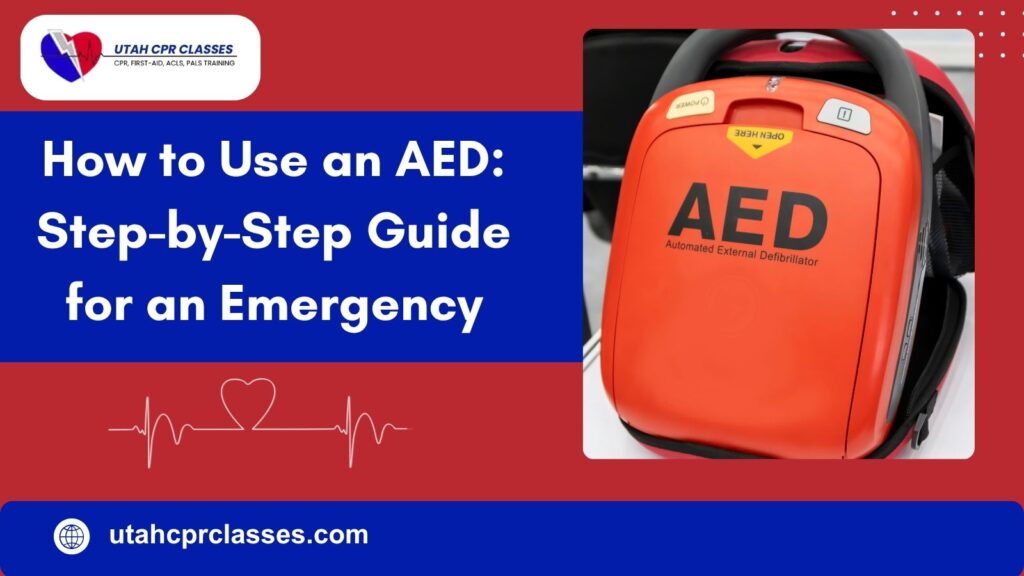
Knowing how to use an AED in Utah can help you respond quickly when someone experiences sudden cardiac arrest. An automated external defibrillator (AED) is designed to analyze a person’s heart rhythm and, when appropriate, deliver an electrical shock that may help restore a normal rhythm.
AEDs are designed for use by both trained responders and members of the public. In Utah, state law allows a person to use an AED without a license, certificate, or other governmental authorization when the person reasonably believes someone is experiencing sudden cardiac arrest. In an emergency, an AED should be used together with Cardiopulmonary Resuscitation (CPR) and emergency medical services. The goal is to begin lifesaving care as quickly as possible while waiting for professional medical help.
In this guide, you’ll learn how to use an AED step by step, when to use it, and what to do in common emergency situations.
What Is an AED?
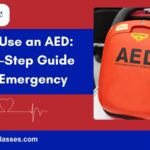
An automated external defibrillator, commonly called an AED, is a portable medical device used during sudden cardiac arrest.
An AED:
- Analyzes the person’s heart rhythm.
- Determines whether a shock may be appropriate.
- Provides voice and/or visual instructions.
- Delivers a defibrillation shock when indicated.
- Guides the rescuer through the emergency response process.
An AED does not replace CPR or emergency medical care. It is one part of the chain of survival.
When Should You Use an AED?
An AED should be used when an adult or child is unresponsive and not breathing normally, which may indicate sudden cardiac arrest.
Signs that an AED may be needed include:
- The person suddenly collapses.
- The person does not respond when spoken to or tapped.
- The person is not breathing normally.
- The person is only gasping.
- The person has no signs of normal circulation.
If someone is unresponsive and not breathing normally, do not wait for an AED before starting CPR if it is not readily available.
How to Use an AED Step by Step When an AED Is Readily Available
When an AED is immediately available, and a person is unresponsive and not breathing normally, use it quickly. An AED is designed to guide the rescuer through the process with voice and visual prompts.
Step 1: Check That the Scene Is Safe
Before approaching the person, make sure there are no immediate dangers to you, the person, or others nearby.
Step 2: Check for Responsiveness and Normal Breathing
Tap the person and speak loudly to see whether they respond.
If the person is unresponsive and not breathing normally or is only gasping, treat the situation as cardiac arrest.
Step 3: Call 911 or Activate the Emergency Response System
Call 911 immediately. If another person is present, have them make the call while you begin using the AED.
If you are alone and have a phone nearby, activate emergency services and put the phone on speaker so you can follow the dispatcher’s instructions while assisting the person.
Step 4: Turn On the AED
Because the AED is already readily available, turn it on as soon as possible.
Some AEDs turn on automatically when the lid is opened, while others require you to press the power button.
Listen carefully to the AED’s voice and visual instructions.
Step 5: Expose the Person’s Chest
Remove clothing from the person’s chest so the AED electrode pads can be placed directly onto bare, dry skin.
If the chest is wet, quickly dry it before applying the pads.
Step 6: Apply the AED Pads
Remove the backing from the adhesive pads and place them firmly on the person’s bare chest.
For a typical adult:
- Place one pad on the upper right side of the chest, below the collarbone.
- Place the second pad on the lower left side of the chest, below the armpit.
Follow the placement diagrams printed on the AED pads if they differ from this general positioning.
Step 7: Let the AED Analyze the Heart Rhythm
Once the pads are connected, the AED will analyze the person’s heart rhythm.
Do not touch the person during the analysis.
Make sure everyone nearby is clear and wait for the AED to tell you what to do.
Step 8: Deliver a Shock if the AED Advises One
If the AED determines that a shock is appropriate, it will tell you to deliver one.
Make sure everyone is clear of the person.
If the AED requires you to press a shock button, press it only after confirming that nobody is touching the person. Some AEDs deliver the shock automatically.
Step 9: Resume CPR Immediately When Instructed
After the shock, follow the AED’s instructions and resume CPR immediately when directed.
If the AED says “no shock advised,” follow its instructions and resume CPR when prompted.
Do not remove the AED pads.
Step 10: Continue Following the AED
Keep the AED connected and continue following its voice and visual prompts.
The AED will periodically reassess the person’s heart rhythm and tell you when to stop CPR for another analysis.
Continue CPR and AED use until:
- The person shows clear signs of life.
- Emergency medical responders arrive and take over.
- Another trained responder takes over.
- The scene becomes unsafe.
- You are physically unable to continue.
Is CPR Required Before Using an AED?
No. CPR is not a prerequisite for using an AED, and there is no requirement to complete a specific number of CPR cycles before applying an AED. If an AED is readily available when a person becomes unresponsive and is not breathing normally, it should be used as soon as possible while CPR is initiated and interruptions are minimized.
If the AED is immediately available, turn it on, follow its voice and visual instructions, and attach the pads to the person’s bare chest. There is no need to complete several rounds of CPR before allowing the AED to analyze the heart rhythm.
However, if an AED is not immediately available, tell someone nearby to retrieve one while you begin CPR. Continue performing CPR until the AED arrives. Once it is available, turn it on, apply the pads, and follow its instructions. The AED will determine whether a shock is appropriate.
What to Do in Each Situation
If the AED is readily available:
- Check for responsiveness and normal breathing.
- Call 911 or have someone call.
- If you are alone, prepare the AED to use it immediately. If there are two individuals, start CPR while another person prepares the AED to use it quickly.
- Turn on the AED and apply the pads as soon as possible.
- Follow the AED’s instructions.
- Resume CPR when instructed.
If the AED is not available:
- Call 911.
- Send someone to retrieve the nearest AED.
- Begin CPR immediately. (Note: If the AED is not available immediately, you should never delay CPR)
- Continue CPR until the AED arrives.
- Apply the AED as soon as it becomes available.
- Follow its instructions and resume CPR when directed.
The key point is that you should never delay AED use just to complete a predetermined number of CPR cycles. When an AED is available, use it as soon as possible while continuing to provide CPR according to the AED’s instructions.
Can You Use an AED on a Child?
AEDs can be used on children, but the appropriate approach depends on the child’s age or size and the AED’s capabilities. Some AEDs have pediatric pads or a pediatric setting that reduces the energy delivered by the device.
If pediatric pads are available and appropriate for the child, use them according to the AED manufacturer’s instructions. If pediatric equipment is unavailable, follow the AED’s instructions and the guidance of emergency dispatchers.
For infants, follow the specific recommendations of the AED manufacturer and current CPR guidelines.
Can an AED Be Used on Someone Who Is Wet?
Yes, but the person’s chest should be dried before the AED pads are applied. Move the person away from standing water when possible and quickly dry the chest.
Never use an AED while the person is lying in a pool of water. The goal is to ensure that the electrode pads have good contact with the skin and that the rescuer and surrounding environment are as safe as possible.
Can an AED Be Used on a Pregnant Person?
Yes. An AED can be used when a pregnant person experiences sudden cardiac arrest. Pregnancy should not prevent a rescuer from performing CPR or using an AED. Follow the AED’s instructions and activate emergency medical services immediately.
Do You Need CPR Training to Use an AED?
AEDs are designed to be used by trained and untrained responders, with the device providing step-by-step instructions. However, CPR and AED training can make a person more confident and prepared during an emergency.
A CPR/AED course typically teaches participants how to:
- Recognize cardiac arrest
- Perform high-quality CPR
- Use an AED
- Position AED pads correctly
- Respond to choking emergencies
- Coordinate with other rescuers
- Follow emergency response procedures
For healthcare professionals, workplace employees, teachers, coaches, childcare providers, fitness professionals, and other individuals with emergency-response responsibilities, completing an appropriate CPR/AED certification course also satisfies workplace or professional requirements.
Why Learning to Use an AED Matters
Sudden cardiac arrest can occur in public places, workplaces, homes, schools, gyms, and other environments. In these situations, an AED provides a way for a rescuer to respond to a potentially fatal cardiac emergency before professional responders arrive.
The combination of early recognition, emergency activation, CPR, and rapid defibrillation forms an important part of the response to sudden cardiac arrest. Learning these skills in advance means you are less likely to hesitate when an emergency occurs.
Learn CPR and AED Skills Before an Emergency
Knowing how to use an AED can help us respond quickly and confidently when sudden cardiac arrest occurs. Whether an AED is immediately available or someone needs to retrieve one, the priority is to activate 911, begin CPR when appropriate, use the AED as soon as it becomes available, and follow its instructions throughout the emergency. While AEDs are designed to guide rescuers through the process, hands-on CPR and AED training can help us recognize cardiac arrest and practice these lifesaving skills before an emergency happens.
If you want or need formal training, Utah CPR Classes offers BLS certification courses that include CPR and AED training, along with ACLS and PALS certification courses. These courses are American Heart Association (AHA) authorized and provide nationally recognized certification for healthcare professionals and others who need verified training. Utah CPR Classes has trained thousands of professionals in CPR, BLS, ACLS, and PALS and has also provided training for hundreds of workplaces, helping organizations prepare their teams to respond effectively during medical emergencies.