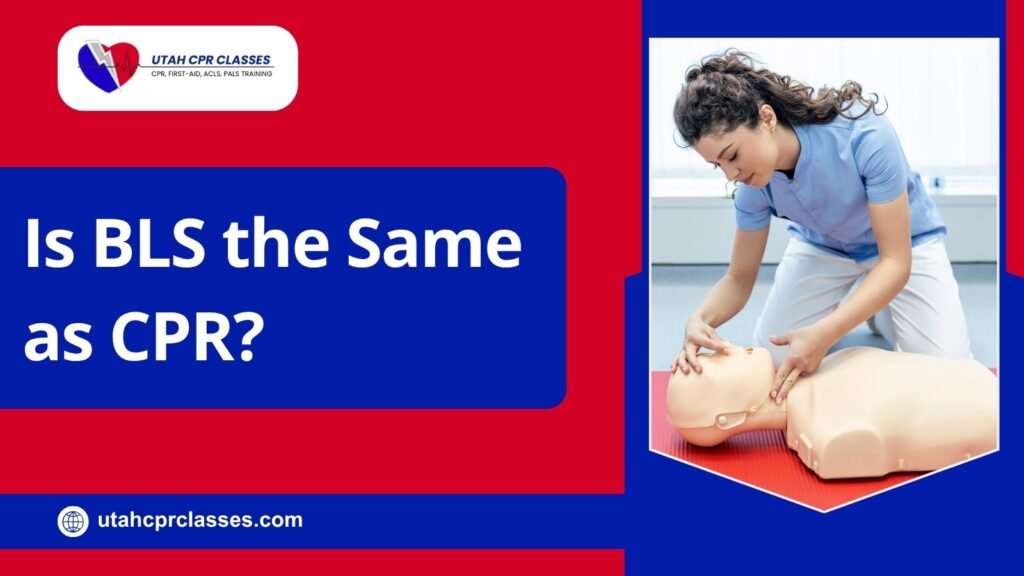
No, BLS is not the same as CPR, although CPR is a core component of BLS training. CPR, or cardiopulmonary resuscitation, is an emergency lifesaving technique used during cardiac arrest, while BLS, or Basic Life Support, is a broader approach to responding to life-threatening emergencies. BLS training typically includes high-quality CPR along with other basic life support skills, such as AED use, rescue breathing, ventilation, and emergency response.
The difference between BLS and CPR certification is especially important for healthcare professionals, students, caregivers, teachers, and workplace employees. While a basic CPR course may meet general CPR and AED training requirements, healthcare employers, schools, and clinical programs may specifically require BLS certification. Understanding what each certification covers can help you choose the right course for your professional or personal needs.
This guide explains the key differences between BLS and CPR, who typically needs each certification, and how BLS and CPR certification renewal works.
What Is CPR?
CPR stands for cardiopulmonary resuscitation. It is an emergency lifesaving procedure used when a person’s heart has stopped effectively pumping blood or the person is not breathing normally. During cardiac arrest, blood flow to the brain and other vital organs stops. Starting CPR as quickly as possible helps maintain circulation until an AED can be used or emergency medical professionals take over.
CPR training typically teaches participants how to:
- Recognize cardiac arrest
- Activate the emergency response system
- Perform high-quality chest compressions
- Provide rescue breaths when appropriate
- Use an automated external defibrillator (AED)
- Respond to choking emergencies
- Perform CPR for adults
- Perform child and infant CPR when included in the course
The exact skills covered depend on the type of CPR course. For example, a general CPR and AED course may be designed for people who do not work in healthcare, while a healthcare-focused course may include additional skills and scenarios. CPR is therefore best understood as a specific lifesaving procedure and a category of emergency training, rather than a synonym for BLS.
What Is BLS?
BLS stands for Basic Life Support. It is a broader approach to responding to life-threatening emergencies, particularly cardiac arrest and respiratory emergencies. BLS training includes CPR but goes beyond basic chest compressions. Depending on the course and certifying organization, BLS training may cover high-quality CPR, AED use, rescue breathing, ventilation, choking relief, and effective team-based resuscitation.
BLS courses commonly emphasize:
- Early recognition of cardiac arrest
- High-quality chest compressions
- Appropriate rescue breathing and ventilation
- AED operation
- Bag-mask ventilation
- Adult, child, and infant basic life support
- Choking response
- Team dynamics and communication
- Coordinated response during resuscitation
For healthcare providers, BLS training is designed around situations in which multiple rescuers and healthcare-specific equipment may be involved. This is why BLS should not simply be described as “CPR for healthcare workers.” CPR is an essential part of BLS, but BLS encompasses a broader set of basic life support knowledge and skills.
BLS vs. CPR: What Is the Difference?
The primary difference between BLS and CPR is what each one covers. CPR focuses on providing chest compressions and ventilations to help maintain circulation and oxygenation during cardiac arrest. BLS incorporates CPR into a broader emergency response framework.
| Feature | CPR | BLS |
| Primary focus | Resuscitation during cardiac arrest | Comprehensive basic emergency life support |
| AED training | May not be included. It varies depending on the course. | Included |
| Rescue breathing | Commonly included | Included |
| Bag-mask ventilation | Usually not a primary focus in basic public CPR | Commonly covered |
| Team dynamics | Depends on course | Important component of healthcare-focused BLS |
| Healthcare-specific response | Depends on course | Stronger emphasis |
| Typical audience | General public or professionals, depending on course | Healthcare professionals and professional rescuers |
| Certification requirements | Vary by employer and course | Often required for healthcare roles |
Is BLS More Advanced Than CPR?
Yes, BLS is generally more comprehensive than a basic CPR course, but it is not quite accurate to describe BLS simply as “advanced CPR.” CPR is a core component of BLS, while BLS covers a broader approach to basic life support and emergency response. The key difference is the scope of training. CPR focuses primarily on recognizing cardiac arrest and performing chest compressions, rescue breathing when appropriate, and AED use. BLS includes high-quality CPR but typically covers additional skills, such as airway management, ventilation, choking response, and coordinated team-based resuscitation.
BLS training is commonly designed for healthcare professionals and others who have a professional responsibility to respond to medical emergencies. CPR training, on the other hand, is widely available to the general public, caregivers, teachers, workplace employees, and other individuals.
Who Usually Needs CPR Certification?
CPR certification is commonly needed by people who may be responsible for responding to emergencies at work, around children, or in community settings. The specific requirement depends on the person’s job, employer, school, or organization.
People who may need CPR certification include:
- Parents and caregivers
- Babysitters
- Teachers and childcare workers
- Coaches and fitness professionals
- Camp counselors
- Workplace employees
- Security personnel
- Students
- Community members
Who Needs BLS Certification?
BLS certification is commonly required for healthcare professionals, healthcare students, and others who may be responsible for responding to cardiac or respiratory emergencies in a professional setting. The exact requirement varies by employer, school, clinical program, and profession.
People who may need BLS certification include:
- Nurses and nursing students
- Physicians and medical students
- Dentists and dental professionals
- EMTs and paramedics
- Respiratory therapists
- Medical assistants
- Other healthcare professionals and support staff
BLS and CPR Certification Renewal
BLS and CPR certifications must be renewed periodically to keep your emergency-response skills and credentials current. Many certifications are valid for about two years, although the exact renewal period depends on the training provider, employer, or professional organization.
Renewal training may review essential skills such as:
- CPR and chest compressions
- AED use
- Rescue breathing
- Airway and breathing support
- Emergency response techniques
BLS renewal is not necessarily the same as CPR renewal. If your employer specifically requires BLS certification, make sure you complete a BLS renewal course that meets its requirements.
Get the Right CPR or BLS Certification for Your Needs
BLS and CPR are closely related, but they are not the same. CPR is a lifesaving technique and type of emergency training, while BLS provides a broader approach to basic life support that includes CPR and other emergency response skills. If you need certification for work, school, healthcare training, or personal preparedness, choose the course that matches your specific requirements. Always check with your employer, school, or professional organization to confirm whether you need CPR or BLS certification and which training provider or course format they accept.
For those who need a convenient and credible BLS certification option in Utah, Utah CPR Classes provides American Heart Association-authorized BLS certification classes for healthcare professionals and other eligible learners. You can complete the online portion and then attend an in-person, self-guided skills session where you practice with a training manikin and receive live feedback. With experience certifying thousands of healthcare professionals in Utah, Utah CPR Classes offers a convenient way to complete recognized BLS training while building the hands-on skills needed to respond effectively in an emergency.