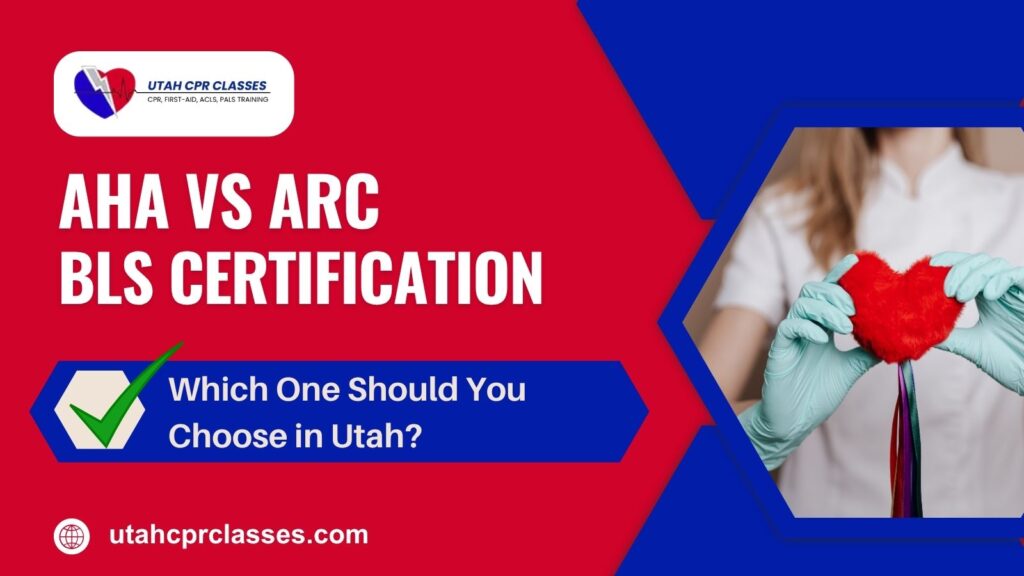
If you are a healthcare professional, first responder, or healthcare student, you may be wondering whether you should choose American Heart Association (AHA) BLS certification or American Red Cross (ARC) BLS certification. Both are well-known providers of Basic Life Support training, but their courses are separate programs with differences in course structure, training approach, certification credentials, and acceptance requirements. Choosing the right certification is especially important if you need BLS for employment, clinical rotations, or a professional requirement.
AHA and American Red Cross BLS courses cover many of the same fundamental lifesaving skills, including high-quality CPR, AED use, rescue breathing, airway management, and recognition of cardiac arrest. However, similarities in the skills taught do not necessarily mean that the two certifications are interchangeable. Your employer, school, healthcare organization, or credentialing body may specify which BLS provider you must use.
This guide compares AHA vs American Red Cross BLS certification to help you understand how the two programs are similar, where they differ, how acceptance can vary, and which option may be appropriate for your professional needs.
Are AHA and American Red Cross BLS Certifications Similar?
Yes. AHA BLS and American Red Cross BLS are similar in their overall purpose and core resuscitation skills. Both are designed to prepare healthcare professionals and other qualified responders to recognize life-threatening emergencies and provide effective basic life support. Both BLS certifications from the American Heart Association and the American Red Cross are valid for two years and require renewal.
Both programs address essential skills such as:
- High-quality CPR
- Automated external defibrillator (AED) use
- Recognition of cardiac arrest
- Rescue breathing and ventilation
- Management of an obstructed airway
- Adult, child, and infant resuscitation
- Single-rescuer and team-based response
- Effective emergency communication and coordination
Therefore, someone comparing the two should not assume that one teaches CPR while the other does not. Both are professional-level BLS programs built around core resuscitation competencies.
What Is the Difference Between AHA and American Red Cross BLS?
Although the American Heart Association (AHA) and American Red Cross (ARC) both provide BLS certification, they are separate training programs developed and administered by different organizations.
The differences that matter most when comparing them include course design, training approach, certification credentials, employer requirements, and training networks. Below are some of the key differences that can help you choose the course that best fits your needs.
Course Design and Training Approach
The AHA BLS course follows the American Heart Association’s established BLS curriculum and training methodology. Its course is structured around the AHA’s approach to resuscitation education, with emphasis on performing BLS interventions effectively and working as part of a resuscitation team.
The American Red Cross BLS course follows the Red Cross’s own curriculum and educational approach. Its program incorporates scenario-based learning, critical thinking, teamwork, communication, and clinical decision-making. As a result, while the two programs address many of the same BLS competencies, the way participants learn and practice those competencies can differ.
Course and Skills-Testing Structure
AHA and American Red Cross provide different certification pathways and course structures. AHA offers options such as its instructor-led BLS course and HeartCode BLS, which combines online coursework with a hands-on skills session. The specific course format determines how participants complete the educational and practical components.
The American Red Cross also provides instructor-led and blended-learning BLS options, but these follow the Red Cross’s own course structure and certification process. This difference can matter to participants who need a particular learning format, skills-testing process, or class arrangement to satisfy a workplace or educational requirement.
Certification Credential
Another clear distinction is the credential issued by each organization. Participants who successfully complete the applicable AHA BLS course receive an AHA BLS Provider Course Completion eCard, identifying the American Heart Association as the organization behind the certification.
Participants who complete an American Red Cross BLS course receive a Red Cross BLS certificate. Although both credentials demonstrate completion of BLS training, they are separate certifications. An employer, school, or healthcare organization may specifically request one organization’s credential rather than treating the two as interchangeable.
Employer and School Requirements
The most important practical difference for many healthcare professionals is which certification an employer or educational institution requires. Some hospitals, healthcare systems, nursing programs, medical programs, and other organizations specifically state that an AHA BLS Provider certification is required.
Other organizations may accept American Red Cross BLS or explicitly accept BLS certification from either AHA or Red Cross. Therefore, we should not assume that completing one organization’s course automatically satisfies every BLS requirement. The exact wording of the employer, school, clinical program, or credentialing organization should be checked before registration.
Training Provider Network
AHA and American Red Cross operate through different training networks.
AHA BLS courses are offered through AHA-authorized Training Centers and instructors. The AHA does not directly conduct every BLS class; instead, its authorized training network delivers the courses.
American Red Cross BLS courses are provided through the Red Cross’s own training network and its training partners.
As a result, class availability, locations, schedules, and course pricing can differ significantly depending on your area.
Is AHA BLS More Widely Accepted Than Red Cross BLS in Utah?
Yes, American Heart Association (AHA) BLS is more widely accepted by U.S. and Utah hospitals and healthcare systems than American Red Cross (ARC) BLS. While both organizations base their training on the same core resuscitation science, hospitals, acute-care facilities, and clinical employers frequently default to requiring an AHA BLS Provider credential. AHA BLS is also commonly listed as a mandatory requirement by hospital networks and some travel nursing agencies, making it a common choice for healthcare professionals who need certification for clinical employment or credentialing.
The American Heart Association also plays a major role in establishing widely used resuscitation guidelines and clinical training standards, which contributes to the widespread use of its BLS credential in healthcare settings. Another difference is the passing score, with AHA commonly requiring 84% compared with 80% for Red Cross BLS. ARC BLS remains widely accepted in community, dental, and outpatient clinic settings, although some specialized hospital departments may specifically require AHA certification.
For professionals who are unsure about their employer’s requirements, choosing AHA BLS can be the safer option, while those whose employer explicitly accepts ARC BLS can use that certification.
Which BLS Certification Should You Choose: AHA or Red Cross?
The best choice depends primarily on the requirements you need to satisfy.
Choose AHA BLS if:
- Your employer specifically requires AHA BLS.
- Your hospital or healthcare organization lists AHA as its required provider.
- Your nursing, medical, dental, or other healthcare program requires an AHA BLS Provider card.
- You need to maintain an AHA-specific credential for employment or clinical compliance.
Choose American Red Cross BLS if:
- Your employer accepts American Red Cross BLS.
- Your school or clinical program accepts Red Cross certification.
- Your organization allows BLS certification from either AHA or Red Cross.
- The Red Cross course format, schedule, or location works better for you.
How Can You Get BLS Certified in Utah?
Getting BLS certification in Utah typically involves choosing an approved training provider, completing the required BLS coursework, demonstrating your skills, and receiving your certification credential. The exact process can vary depending on whether you need BLS for a healthcare job, nursing or medical school, EMS licensing, or another professional requirement.
To get BLS certified in Utah, you generally need to:
- Check the requirement – First, confirm whether our employer, school, healthcare program, or licensing organization requires a specific BLS provider, such as AHA or Red Cross.
- Choose an approved BLS course – Select a course designed for healthcare professionals and other providers who need professional-level BLS training. The AHA offers both classroom and blended-learning BLS options.
- Complete the training – Depending on the course format, we may complete the BLS instruction in a classroom or complete an online portion followed by an in-person skills session. Blended AHA HeartCode BLS, for example, requires a hands-on skills component.
- Pass the required skills evaluation – Participants must demonstrate their BLS skills during the practical portion of the course. For Utah EMS licensing requirements, the state specifically requires an in-person skills evaluation by an instructor.
- Receive the certification – After successfully completing the required course components, we receive the applicable BLS certification card. An AHA BLS Provider completion card is valid for two years.
- Renew before expiration – BLS certification must be renewed according to the requirements of the issuing organization and our employer or licensing authority. Checking these requirements before the card expires helps us maintain uninterrupted compliance.
Why Choose Us for AHA BLS Certification in Utah?
Choosing the right training provider is important when you need BLS certification for a healthcare job, school, or professional requirement. Utah CPR Classes provides American Heart Association-authorized BLS training for healthcare professionals, students, and workplace teams across Utah, with flexible course options designed to make certification convenient while providing the required hands-on training.
Here are some of the reason to choose us for your AHA BLS training:
- AHA-Authorized Training – Complete an official American Heart Association BLS course and receive an AHA BLS Provider eCard after meeting the course requirements.
- Flexible Learning Options – Choose a convenient training format, including blended learning with online coursework followed by an in-person hands-on skills session.
- Multiple Utah Locations – Find BLS training in communities across Utah, including Salt Lake City, American Fork, South Jordan, Orem, Provo, Ogden, Sandy, and more.
- Same-Day Certification – Receive your official AHA eCard after successfully completing the required course components.
- Initial Certification and Renewal – Enroll for BLS training whether you are getting certified for the first time or renewing an existing credential.
- Convenient Scheduling – Select available weekday, evening, or weekend classes that fit around your work or school schedule.
- Hands-On Skills Training – Practice essential BLS skills and complete your skills evaluation using Voice-Assisted Manikins (VAMs).
- Training Support – Get guidance throughout the certification process and assistance when you need additional support during training.
Conclusion
AHA BLS and Red Cross BLS both provide essential lifesaving training, but AHA BLS is generally the safer choice for healthcare professionals seeking broad acceptance, particularly in hospitals and clinical settings. Both certifications can meet professional BLS requirements when accepted by the relevant organization. However, requirements can vary between employers, schools, and licensing bodies, so checking the specific requirements before enrolling can help ensure you choose the right certification for your career or professional needs.
If you are looking for AHA BLS certification in Utah, Utah CPR Classes offers AHA-authorized BLS training with convenient course options and multiple locations across the state. Whether you need BLS for a healthcare job, nursing or medical program, clinical requirement, or renewal, you can choose a course that fits your schedule and complete the required hands-on skills training.
Enroll in an AHA BLS class today to earn your certification and stay prepared to respond to life-threatening emergencies.